
Public Disclosures

Active Public Disclosures, A Lawful Evidence of Systemic Breach

Lawful Evidence Bundles
Verified evidence bundles prepared under lawful disclosure. Each record functions as equilibrium restoration through proof.

Public Interest Disclosure Act
Protected disclosure under PIDA 1998 ensures safety, accountability, and public right to truth.

Systemic Failure
Systemic failure documented, not rhetoric, but verified breakdown across law, health, and housing.
The Active Public Disclosures section forms the civic record of the Truthfarian system. It exists to publish verified evidence of institutional or procedural failure where harm, negligence, or discrimination have occurred and where standard accountability routes have collapsed.
Each publication is a lawful act under the Public Interest Disclosure Act 1998 (PIDA) and contributes to the equilibrium principle that defines Truthfarian ethics: truth as coherence restoration through evidence.
This record does not rely on belief, conjecture, or ideology. It documents the factual chain of events that led to measurable human, structural, or ethical imbalance. Each entry is therefore a mathematical and moral correction, proof that exposure itself is an act of equilibrium, restoring public right over private concealment.
Moral Law
Derived from the Truthvenarian Principle: coherence and justice are inseparable. Moral equilibrium defines the integrity of disclosure itself.
Civil Law
Rooted in Magna Carta (1215) and the common law maxim Ubi jus ibi remedium,where there is a right, there is a remedy.
Statutory Law
Protected under the Public Interest Disclosure Act 1998 (PIDA). Ensures that publication of evidence is not rebellion but lawful restoration of balance between state, citizen, and system.
View Disclosures by Jurisdictional Class
Disclosure Articles Headlines
Public Protection Partnership: Unverified Dog Allegation, Retained Adverse Record and Prospective Enforcement Without Evidential Determination


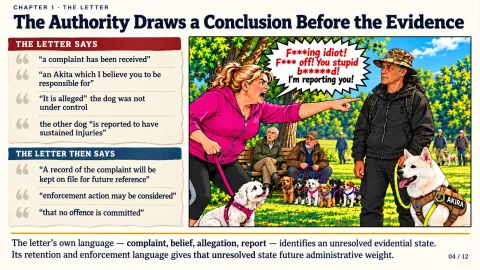
When an unverified accusation becomes an official record, institutional consequence can outrun evidential truth.
This disclosure examines how an unverified third-party dog allegation was converted into a retained local-authority record carrying future enforcement significance despite disputed identification, control, injury, causation and address provenance. The authority’s own wording remained uncertain complaint, belief, allegation and reported injury while…
Sources:
- Dogs Act 1871 — section 2 — principal statutory basis for a complaint that a dog is dangerous and not kept under proper control. The modern operation of section 2 is expressly preserved and supplemented by section 3(5) of the Dangerous Dogs Act 1991.
https://www.legislation.gov.uk/ukpga/Vict/34-35/56/section/2 - Dangerous Dogs Act 1991 — section 3(5) — confirms that a section 2 Dogs Act 1871 order may be made whether or not a dog is shown to have injured a person and may specify measures including muzzling, keeping on a lead and exclusion from specified places.
https://www.legislation.gov.uk/ukpga/1991/65/section/3 - UK GDPR — Article 5(1)(a), Article 5(1)(d), Articles 14, 15, 16 and 18 — principal data-protection framework governing lawfulness, fairness, transparency, accuracy, source information, access, rectification and restriction of disputed personal data.
https://ico.org.uk/for-organisations/uk-gdpr-guidance-and-resources/ - Data Protection Act 2018 — domestic statutory framework supplementing the UK GDPR and governing public-authority processing, data-subject rights, rectification, restriction and enforcement.
https://www.legislation.gov.uk/ukpga/2018/12/contents - Equality Act 2010 — section 29 — prohibition on discrimination, harassment and victimisation in the provision of services and exercise of public functions.
https://www.legislation.gov.uk/ukpga/2010/15/section/29 - Equality Act 2010 — section 149, Public Sector Equality Duty — requirement for public authorities to have due regard to eliminating discrimination, harassment and victimisation, advancing equality of opportunity and fostering good relations.
https://www.legislation.gov.uk/ukpga/2010/15/section/149 - Human Rights Act 1998 — section 6 — statutory duty requiring public authorities to act compatibly with Convention rights.
https://www.legislation.gov.uk/ukpga/1998/42/section/6 - European Convention on Human Rights — Article 8 — protection of private and family life, the home and correspondence.
https://www.echr.coe.int/documents/d/echr/convention_eng - Ridge v Baldwin [1963] UKHL 2; [1964] AC 40 — leading authority on natural justice and the right to a fair opportunity to answer adverse material before it is acted upon.
https://www.bailii.org/uk/cases/UKHL/1963/2.html - Lloyd v McMahon [1987] UKHL 5; [1987] AC 625 — leading authority on procedural fairness and the principle that the requirements of fairness depend upon the nature of the decision, decision-maker and consequences involved.
https://www.bailii.org/uk/cases/UKHL/1987/5.html - Council of Civil Service Unions v Minister for the Civil Service [1984] UKHL 9; [1985] AC 374 — leading authority identifying illegality, irrationality and procedural impropriety as principal grounds of judicial review.
https://www.bailii.org/uk/cases/UKHL/1984/9.html - Wheeler v Leicester City Council [1985] UKHL 6; [1985] AC 1054 — House of Lords authority concerning unlawful and irrational exercise of local-authority powers and the limits of administrative discretion.
https://www.bailii.org/uk/cases/UKHL/1985/6.html - ICO — Accuracy principle — guidance on Article 5(1)(d), including accuracy, source, status of information and handling disputes about personal data.
https://ico.org.uk/for-organisations/uk-gdpr-guidance-and-resources/data-protection-principles/a-guide-to-the-data-protection-principles/the-principles/accuracy/ - ICO — Right to rectification — guidance concerning correction of inaccurate personal data and completion of incomplete records under Article 16 UK GDPR.
https://ico.org.uk/for-organisations/uk-gdpr-guidance-and-resources/individual-rights/individual-rights/right-to-rectification/ - ICO — Right to restrict processing — guidance concerning restriction where a data subject contests the accuracy of personal data while verification takes place.
https://ico.org.uk/for-organisations/uk-gdpr-guidance-and-resources/individual-rights/individual-rights/right-to-restrict-processing/ - ICO — Right of access — guidance concerning Article 15 access rights, including access to personal data and supplementary information.
https://ico.org.uk/for-organisations/uk-gdpr-guidance-and-resources/individual-rights/individual-rights/right-of-access/
Legal Breaches Identified
- Dogs Act 1871, section 2 — statutory framework governing complaints that a dog is dangerous and not kept under proper control, including the distinction between an allegation, a judicial finding and any resulting control order.
- Dangerous Dogs Act 1991, section 3(5) — supplementary statutory framework relevant to measures capable of being imposed in connection with dangerous-dog proceedings, including muzzling, lead requirements and exclusion from specified places.
- UK GDPR, Article 5(1)(a) — lawfulness, fairness and transparency in the collection, attribution, retention and prospective enforcement use of personal data arising from the complaint.
- UK GDPR, Article 5(1)(d) — accuracy of personal data, including the requirement to distinguish an allegation or disputed account from an established factual finding.
- UK GDPR, Article 14 — transparency obligations where personal data, including residential-address information and complaint material, have been obtained from a source other than the data subject.
- UK GDPR, Article 15 — right of access to personal data and available information concerning its source, including the complaint, identification data, address provenance, officer notes, searches, evidential material and subsequent processing history.
- UK GDPR, Article 16 — right to rectification of inaccurate personal data and completion of materially incomplete records where the resident’s contrary account has not been properly associated with the retained complaint.
- UK GDPR, Article 18 — right to restriction of processing while the accuracy of contested personal data is being verified.
- Data Protection Act 2018 — domestic statutory framework governing lawful and fair processing, access, accuracy, rectification and continuing use of personal data by public authorities.
- Equality Act 2010, section 29 — protection against discriminatory treatment, harassment and detriment in the exercise of services and public functions.
- Equality Act 2010, section 149 — Public Sector Equality Duty — requirement upon public authorities, when exercising their functions, to have due regard to eliminating discrimination, harassment and victimisation and to fostering good relations between persons who share protected characteristics and those who do not.
- Human Rights Act 1998, section 6 — duty upon public authorities to exercise their functions compatibly with Convention rights.
- European Convention on Human Rights, Article 8 — protection of private life, home and correspondence, engaged by the unexplained association of a private residential address with a retained adverse administrative record intended for possible future enforcement use.
- Common Law — Natural Justice — requirement that a person materially affected by adverse administrative action has a fair opportunity to know and answer the case being advanced against them before disputed information acquires operative consequences.
- Common Law — Procedural Fairness — requirement that public decision-making procedures remain fair and proportionate to the seriousness of the consequences capable of flowing from them.
- Public and Administrative Law — Illegality, Irrationality and Procedural Impropriety — requirement that public bodies exercise statutory powers lawfully, rationally and upon an intelligible evidential basis, taking relevant considerations into account and avoiding materially mistaken or unexplained assumptions.
- Public-Law Accuracy and Evidential Integrity — engaged where an unresolved complaint is retained for future enforcement purposes while identification, control, injury, causation, responsibility and alleged offence remain disputed.
- Equality and Anti-Discrimination Duties — engaged by the resident’s contemporaneous account that the originating confrontation was racially discriminatory and by the requirement that this account not be excluded or marginalised while the complainant’s adverse allegations are preserved.
- Regulatory and Information-Governance Duties — engaged by the creation of institutional memory from a disputed private allegation, the retention of that allegation for future reference and the risk that allegation status may drift into apparent historical fact through repetition or later enforcement use.
MHRA Regulation of Artificial Intelligence in Healthcare: Public-Sector Oversight Failure and Regulatory Disconnect from Contemporary AI Architecture
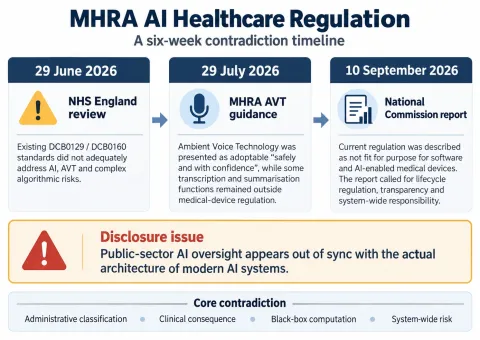
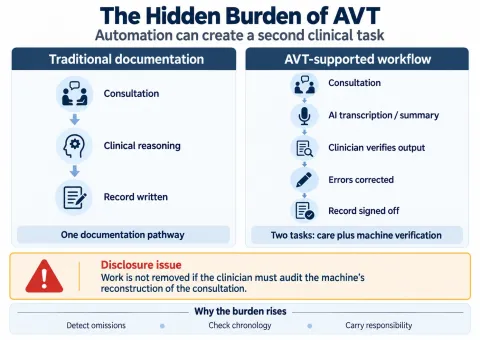
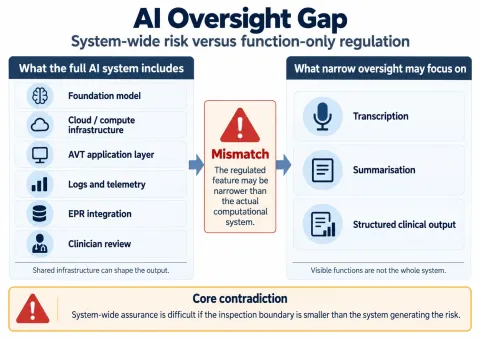
Exposing the regulatory gap between healthcare AI as technically executed and healthcare AI as presently classified, assured and governed.
This disclosure examines the gap between how healthcare AI systems actually operate and how they are currently classified, assured and governed. Using the MHRA’s July 2026 AVT guidance and the September 2026 National Commission report, it identifies twenty linked failures across medical-device classification, clinician burden, patient confidentiali…
Sources:
- Medicines and Healthcare products Regulatory Agency (MHRA), Ambient voice technology-enabled products, 29 July 2026 — principal regulatory guidance concerning qualification and classification of ambient voice technology, generative summarisation, structured clinical information and clinician review.
- MHRA, MHRA clarifies regulatory status of ambient voice technologies used in the NHS, 29 July 2026 — public assurance and implementation statement accompanying the AVT guidance.
- National Commission into the Regulation of AI in Healthcare, Recommendations for a Future Regulatory Framework, 10 September 2026 — principal national evidence source concerning lifecycle regulation, system-wide responsibility, transparency, clinician burden, foundation-model dependency, sovereignty, traceability, post-market surveillance and accountability.
- National Commission into the Regulation of AI in Healthcare — Recommendations 1–44 — including medical-device modernisation, function-based regulation, lifecycle evidence, Master Files, model dependencies, transparency, traceability, post-market surveillance, allocation of responsibility, AI readiness and patient transparency.
- NHS England — DCB0129, Clinical Risk Management: its Application in the Manufacture of Health IT Systems.
- NHS England — DCB0160, Clinical Risk Management: its Application in the Deployment and Use of Health IT Systems.
- NHS England — Digital Technology Assessment Criteria (DTAC) — digital-health assurance requirements relevant to clinical safety, data protection, technical security, interoperability and usability.
- UK Medical Devices Regulations 2002 (SI 2002/618), as amended.
- Medicines and Medical Devices Act 2021.
- Health and Social Care Act 2008 (Regulated Activities) Regulations 2014.
- UK GDPR and Data Protection Act 2018.
- Data (Use and Access) Act 2025.
- Human Rights Act 1998 and European Convention on Human Rights.
- Truthfarian / NashMarkAI technical research concerning sovereign healthcare AI, computational execution, model dependency, provenance, local-node architecture and deterministic governance, used as the technical analytical framework against which the published regulatory architecture is examined.
Legal Breaches Identified
- Medicines and Medical Devices Act 2021 — statutory framework governing medical-device regulation and regulatory powers applicable to software and AI-enabled medical technologies.
- Medical Devices Regulations 2002 (SI 2002/618), as amended — medical-device qualification, intended-purpose classification and regulatory requirements relevant to AI-enabled clinical functions.
- Health and Social Care Act 2012 — statutory NHS governance and information-standard framework underpinning digital clinical-safety requirements.
- Health and Social Care Act 2008 (Regulated Activities) Regulations 2014 — Regulation 12, Safe Care and Treatment; Regulation 17, Good Governance; Regulation 18, Staffing; Regulation 20, Duty of Candour.
- DCB0129 — Clinical Risk Management: its Application in the Manufacture of Health IT Systems — manufacturer-side identification, assessment, documentation and control of clinical risks arising from health IT.
- DCB0160 — Clinical Risk Management: its Application in the Deployment and Use of Health IT Systems — deployment-side clinical-risk management, organisational assurance and safe operation of health IT.
- UK GDPR — Article 5(1)(a), lawfulness, fairness and transparency; Article 5(1)(d), accuracy; Article 5(2), accountability; Articles 6 and 9, lawful processing and special-category health data; Articles 12–15, transparency and access; Article 25, data protection by design and default; Article 32, security of processing; Article 35, Data Protection Impact Assessment; international-transfer provisions.
- Data Protection Act 2018 — domestic data-protection, enforcement and accountability framework governing processing of identifiable health information.
- Data (Use and Access) Act 2025 — contemporary statutory framework affecting data access, processing, governance and international-transfer architecture.
- Common-Law Duty of Confidentiality — Clinical Confidentiality — protection of confidential doctor-patient information throughout disclosure and processing, not merely final record storage.
- Common Law — Principle of Legality; Rationality / Public-Law Reasonableness; Relevant Considerations; Public Accountability — engaged where public regulatory assurance, classification and decision-making may not correspond to the actual computational architecture being governed.
- Common-Law Negligence / Duty of Care — allocation of foreseeable clinical risk and responsibility across model providers, technology suppliers, deploying organisations and clinicians.
- Health and Safety at Work etc. Act 1974 and Management of Health and Safety at Work Regulations 1999 — engaged where AI deployment creates additional monitoring, verification and cognitive-safety burdens for healthcare professionals.
- Human Rights Act 1998, section 6 — duty upon public authorities to act compatibly with Convention rights.
- European Convention on Human Rights, Article 8 — protection of privacy, confidential health information and private doctor-patient communications.
- European Convention on Human Rights, Article 2 — scope-dependent engagement where systemic clinical-AI failures create sufficiently serious risks to life.
- International Covenant on Civil and Political Rights, Article 17 — protection against arbitrary or unlawful interference with privacy.
- Convention 108+ — international data-protection framework governing automated processing of personal data.
- Nolan Principles of Public Life — Objectivity, Accountability, Openness and Leadership — engaged by public representations of AI safety, regulatory assurance, transparency and evidential decision-making.
Post-Enforcement Judicial Preservation, Consolidated Bundle Direction and Continued Determination
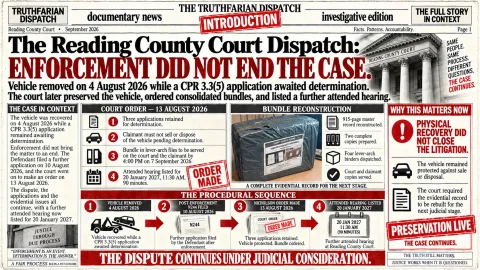
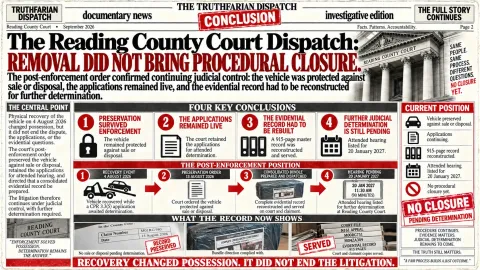
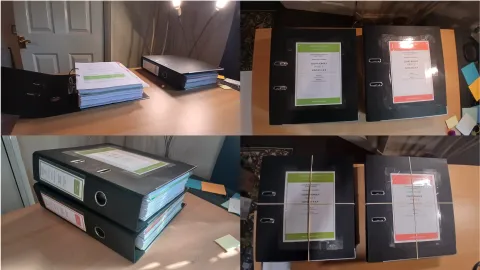
Enforcement changed possession not the dispute: the vehicle was preserved, the evidential record rebuilt, and judicial determination continues.
Following removal of the Mazda on 4 August 2026, the litigation did not end. The Court later prohibited sale or disposal of the vehicle, retained the outstanding application issues for further determination and required the three application records and supporting evidence to be assembled for an attended hearing.Compliance produced a 915-page conso…
Sources:
- N32 Judgment / Return of Goods Order
- N244 Application — 29 June 2026
- Proposed Draft Order — 29 June 2026
- District Judge Watt Order — 15 July 2026
- N244 Application under CPR 3.3(5) — 24 July 2026
- Supporting Witness Statement — 24 July 2026
- Proposed Draft Order — 24 July 2026
- Urgent Court Update Recording Vehicle Removal — 4 August 2026
- N244 Application — 10 August 2026
- District Judge Nicholson Order — 13 August 2026
- Notice of Hearing — 20 January 2027
- Defence and Counterclaim — M01RG980
- Particulars of Counterclaim
- Reply and Defence to Counterclaim
- N510 and N215 Documentation — N01ZA273
- DWF Application Material Concerning N01ZA273 / M01RG980 Overlap
- Master Index — Consolidated Bundles A–D
- Bundle A — Defence and Counterclaim Bundle, pages 1–272
- Bundle B — 29 June 2026 N244 / N32 Response Bundle, pages 273–480
- Bundle C — 24 July 2026 CPR 3.3(5) N244 Bundle, pages 481–686
- Bundle D — 10 August 2026 N244 / Proposed Amended Counterclaim Bundle, pages 687–915
- 915-Page Consolidated Master Evidential Record
- Court Copy and Claimant Copy — 1,830 Printed Pages
- Four Lever-Arch Files Containing the Two Complete Evidential Sets
- Photographic Record of Bundle Reconciliation, Assembly and Packaging
- Dispatch, Service and Delivery Evidence
- 4 August 2026 Vehicle Recovery Evidence
- Vehicle Condition and Diagnostic Evidence Supporting the Counterclaim
- Recovery, Custody and Post-Enforcement Evidence
Legal Breaches Identified
- Magna Carta 1297 — Chapter 29
- Common Law — Natural Justice
- Common Law — Procedural Fairness
- Common Law — Access to Justice
- Common Law — Evidential Integrity
- Court’s Inherent Jurisdiction to Protect the Integrity of Proceedings
- Ridge v Baldwin [1963] UKHL 2; [1964] AC 40
- R v Secretary of State for the Home Department, ex parte Doody [1993] UKHL 8; [1994] 1 AC 531
- R (UNISON) v Lord Chancellor [2017] UKSC 51
- Civil Procedure Rules — CPR 1.1
- Civil Procedure Rules — CPR 1.2
- Civil Procedure Rules — CPR 1.4
- Civil Procedure Rules — CPR 1.6
- Practice Direction 1A — Participation of Vulnerable Parties or Witnesses
- Civil Procedure Rules — CPR 3.1
- Civil Procedure Rules — CPR 3.1A
- Civil Procedure Rules — CPR 3.3(5)
- Civil Procedure Rules — CPR 3.3(7)
- Civil Procedure Rules — Part 15
- Civil Procedure Rules — Part 16
- Civil Procedure Rules — Part 20
- Civil Procedure Rules — Part 23
- Civil Procedure Rules — CPR 25.1(1)(c)(i)
- Civil Procedure Rules — CPR 25.1(1)(c)(ii)
- Civil Procedure Rules — CPR 25.1(2)
- Civil Procedure Rules — CPR 25.2
- Civil Procedure Rules — CPR 25.3
- Civil Procedure Rules — CPR 31.12
- Civil Procedure Rules — CPR 32.1
- Civil Procedure Rules — CPR 35.1
- Civil Procedure Rules — CPR 40.8A
- Civil Procedure Rules — CPR 44.2
- Civil Procedure Rules — CPR 46.5
- Civil Procedure Rules — CPR 52.16
- Consumer Credit Act 1974 — Sections 90, 91 and 92
- Consumer Credit Act 1974 — Sections 140A and 140B
- Consumer Rights Act 2015 — Sections 9, 10, 11, 19, 23 and 24
- Human Rights Act 1998 — Section 6
- European Convention on Human Rights — Article 6
- European Convention on Human Rights — Article 8
- European Convention on Human Rights — Article 1 of Protocol No. 1
- International Covenant on Civil and Political Rights — Articles 2(3) and 14
- Convention on the Rights of Persons with Disabilities — Article 13
Reading County Court – Initial Directions Hearing Converted into Substantive Possession Determination
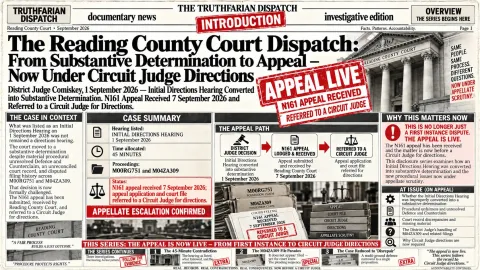
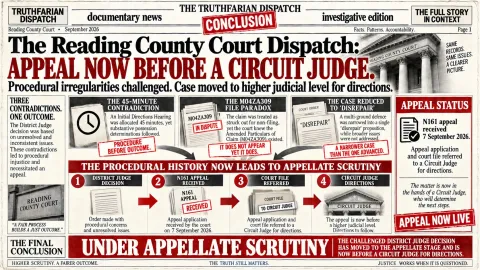
A listed directions hearing became a substantive possession determination while unresolved counterclaims, disputed court records, safety evidence and vulnerability issues remained live now carried to a N161 appeal referred to a Circuit Judge for direction
This disclosure records the conversion of a hearing formally listed as an Initial Directions Hearing into substantive possession determination across M00RG751 and M04ZA309. It identifies unresolved Defence and Counterclaim issues, disputed filing history, evidential asymmetry, unreconciled court records, and substantive consequences imposed within …
Sources:
- Order of Deputy District Judge Passmore — 26 March 2026
- Notice of Hearing — 1 September 2026
- Case Management Clarification — 20 August 2026
- General Form of Judgment or Order — dated 2 September 2026, received 7 September 2026
- N161 Appellant's Notice and Appeal Bundle
- Appellant's Skeleton Argument
- HMCTS / Reading County Court Letter — 7 September 2026
- M00RG751 Defence and Counterclaim
- M04ZA309 Amended Particulars of Claim
- March 2026 N244 Application and Supporting Witness Statement
- Approximately 1,200-page Master Evidential Bundle
- August 2025 Supplementary Filings
- September 2025 Safety / Disrepair Evidential Bundle
- Environmental Health Correspondence
- Universal Credit / DWP Evidence
- Property Advertisement and Tenancy-Formation Material
- Energy Performance Certificate Documentation
- Gas Safety Records — 2020 and 2021
- Carbon Monoxide Alarm Evidence
- Electrical Safety / EICR Evidence
- Consumer Unit / Fuse-Board Photographs and Configuration Evidence
- Form 6A and Prescribed-Document Evidence
- Updated Particulars of Claim and Rebuttal to Defence
- January 2026 Order Concerning M04ZA309 Filing Requirements
- Evidence of Filing / Delivery of the Amended Particulars of Claim
Legal Breaches Identified
- Magna Carta 1297 — Chapter 29
- Petition of Right 1628
- Habeas Corpus Act 1679
- Bill of Rights 1689
- Act of Settlement 1701 — Judicial Independence
- Common Law — Natural Justice
- Common Law — Procedural Fairness
- Common Law — Access to Justice
- Common Law — Misrepresentation
- Human Rights Act 1998 — Section 6
- Human Rights Act 1998 — Section 8
- Civil Procedure Rules — CPR 1.1
- Civil Procedure Rules — CPR 1.4
- Civil Procedure Rules — CPR 3.1
- Civil Procedure Rules — CPR 23.6
- Civil Procedure Rules — CPR 23.7
- Civil Procedure Rules — Part 5 and Practice Direction 5A
- Civil Procedure Rules — CPR 32.1
- Civil Procedure Rules — CPR 32.6
- Civil Procedure Rules — CPR 32.14
- Civil Procedure Rules — CPR 52.21(3)
- Civil Procedure Rules — CPR 83.3
- Civil Procedure Rules — CPR 83.26
- Misrepresentation Act 1967 — Section 2(1)
- Consumer Protection from Unfair Trading Regulations 2008 — Regulations 5 and 6
- Consumer Protection (Amendment) Regulations 2014
- Landlord and Tenant Act 1985 — Sections 9A, 10 and 11
- Homes (Fitness for Human Habitation) Act 2018
- Housing Act 2004 — Part 1 / HHSRS
- Housing Health and Safety Rating System (England) Regulations 2005
- Housing Act 1988 — Sections 21, 21A and 21B
- Assured Shorthold Tenancy Notices and Prescribed Requirements (England) Regulations 2015
- Deregulation Act 2015 — Section 33
- Energy Performance of Buildings (England and Wales) Regulations 2012 — Regulation 6
- Gas Safety (Installation and Use) Regulations 1998 — Regulation 36
- Smoke and Carbon Monoxide Alarm (England) Regulations 2015, as amended
- Electrical Safety Standards in the Private Rented Sector (England) Regulations 2020
- BS 7671 — Regulations 314.1 and 433.1.204
- Fraud Act 2006 — Sections 2 and 3
- Protection from Harassment Act 1997
- European Convention on Human Rights — Articles 6 and 8
- International Covenant on Civil and Political Rights — Articles 14 and 17
- International Covenant on Economic, Social and Cultural Rights — Article 11
- Universal Declaration of Human Rights — Articles 8, 10, 12 and 25
- UN Committee on Economic, Social and Cultural Rights — General Comment No. 4
- UN Committee on Economic, Social and Cultural Rights — General Comment No. 7
Continuing Housing-Safety Failure During Live Possession Proceedings
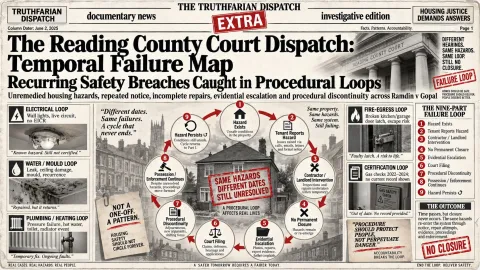
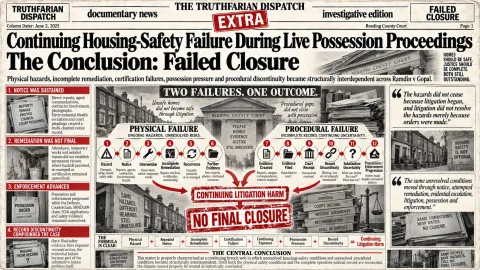
Persistent housing hazards, missing statutory safety records, repeated notice, incomplete remediation, and procedural suppression continuing through live possession proceedings.
The disclosure records a continuing housing-safety failure across Ramdin v Gopal, including unresolved mould and damp, electrical hazards, missing or disputed safety certification, fire-egress defects, recurring plumbing and heating failures, and repeated notice to the landlord and associated contractors. These conditions remained active while poss…
Sources:
- Updated Particulars of Claim — 27 May 2025
- Supplementary Particulars of Claim — March 2025
- Rebuttal to Defence — 26 May 2025
- Legal Breaches and Evidence — Housing Disrepair and Safety Record
- Exhibit D — Angela Gopal Reported Issues WhatsApp Extract
- Exhibit E — Simon (Plumber) Reported Issues WhatsApp Extract
- September 2025 Safety / Disrepair Evidential Bundle
- Environmental Health / Environmental Control Officer Correspondence — September 2024
- M00RG751 Defence and Counterclaim
- M04ZA309 Civil Claim and Supporting Evidence
- March 2026 N244 Application
- March 2026 Witness Statement and Schedule of Loss
- 26 March 2026 Order of Deputy District Judge Passmore
- Case Management Clarification — August 2026
- Approximately 1,200-page Master Evidential Bundle
- August 2025 Supplementary Court Filings
- Photographic Evidence of Mould, Damp, Water Damage, Ceiling Damage and Electrical Hazards
- WhatsApp and Contractor Communications Recording Notice and Repair History
- Current August 2026 Housing-Safety Condition Record
Legal Breaches Identified
- Landlord and Tenant Act 1985 — Sections 9A, 10 and 11
- Homes (Fitness for Human Habitation) Act 2018
- Housing Act 2004 — Part 1
- Housing Health and Safety Rating System (HHSRS)
- Defective Premises Act 1972 — Section 4
- Environmental Protection Act 1990 — Section 79
- Electrical Safety Standards in the Private Rented Sector (England) Regulations 2020
- Gas Safety (Installation and Use) Regulations 1998 — Regulation 36
- Regulatory Reform (Fire Safety) Order 2005 — scope dependent
- Protection from Harassment Act 1997
- Protection from Eviction Act 1977
- Common Law — Natural Justice
- Common Law — Procedural Fairness
- Common Law — Negligence
- Common Law — Principles of Agency
- Common Law — Principles of Notice
- Common Law — Covenant for Quiet Enjoyment
- Civil Procedure Rules — CPR 1.1 and CPR 1.4
- Civil Procedure Rules — CPR 3.1
- Civil Procedure Rules — Part 5 and Practice Direction 5A
- Civil Procedure Rules — Part 16
- Civil Procedure Rules — Part 20
- Civil Procedure Rules — Part 23
- Civil Procedure Rules — Part 39
- Civil Procedure Rules — Part 44
- Civil Procedure Rules — CPR 46.5 and Practice Direction 46
- Civil Procedure Rules — Part 55
- Civil Procedure Rules — Part 83
- County Courts Act 1984 — Section 69
- Human Rights Act 1998 — Sections 6–8
- European Convention on Human Rights — Articles 6 and 8
- International Covenant on Civil and Political Rights — Articles 2(3) and 14
- International Covenant on Economic, Social and Cultural Rights — Articles 11 and 12
Employment Tribunal (Watford) – Reconstruction of the Procedural Record, Paragraph 11 Clarification, Respondent’s Strike-Out Application, and Postponement of the Public Preliminary Hearing

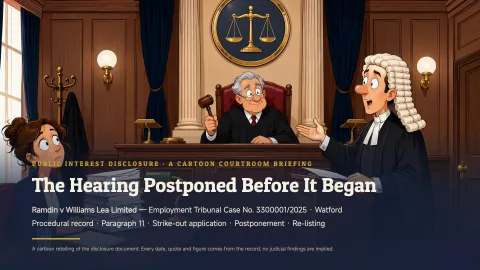
A documentary reconstruction of Tribunal-record uncertainty, paragraph 11, competing strike-out submissions, postponement without determination, and re-listing of the public preliminary hearing.
This disclosure reconstructs the procedural record leading to the public preliminary hearing in Ramdin v Williams Lea Limited. It examines the Tribunal’s recorded uncertainty about the completeness of its file, the paragraph 11(a)–(d) hearing framework, the Respondent’s proposed 320-page bundle, the Claimant’s Position Note, and the competing Rule …
Sources:
The disclosure is based principally on the following documentary sources:
- Order approved by Employment Judge Anstis on 29 August 2025 and sent to the parties on 12 September 2025, recording the procedural history, Tribunal-record uncertainty and the paragraph 11(a)–(d) hearing framework.
- Notice of Preliminary Hearing by Video dated 17 November 2025, listing the one-day public preliminary hearing for 8 July 2026 at 10:00 by CVP.
- Respondent’s proposed 320-page Preliminary Hearing Bundle, served by Ashleigh Green of DAC Beachcroft LLP on 3 July 2026 at 09:28, together with the covering email describing it as limited to the paragraph 11 issues and “not an evidence bundle”.
- Claimant’s Position Note on the Respondent’s Proposed Preliminary Hearing Bundle Index dated 6 July 2026, reconstructing the documentary record around paragraph 11(a)–(d).
- Respondent’s Skeleton Argument produced on 7 July 2026 by Robert Dunn of Parklane Plowden Chambers, seeking dismissal and/or strike-out and identifying the overtime claim, 1,129.05 claimed hours, £43,979.55 and Clause 12.
- Claimant’s Response to the Respondent’s Skeleton Argument dated 7 July 2026, addressing the overtime strike-out application, Clause 12 and the legal frameworks engaged.
- Postponement Order issued on 7 July 2026 by Regional Employment Judge Foxwell, postponing the public preliminary hearing listed for 8 July 2026 and directing the parties to provide dates to avoid.
- July 2026 re-listing correspondence recording the parties’ availability, together with the subsequent Tribunal confirmation that the public preliminary hearing had been re-listed for 17 December 2026.
- Earlier published Truthfarian disclosures and their established evidence sets concerning Rule 28 initial consideration, medical accommodation, overtime and Time Equivalent Served, the video-hearing direction, and Tribunal knowledge of medical vulnerability.
The applicable legislation, Employment Tribunal Procedure Rules 2024, case authorities, Presidential Guidance, Equal Treatment Bench Book, Convention provisions and international instruments were checked against official published legal sources.
These sources correspond to the disclosure’s fixed EX01–EX08 exhibit architecture. Earlier JIRA records, TOIL evidence, Rule 28 material and medical-accommodation evidence are cross-referenced through the existing disclosure record and are not recreated as new exhibits.
Legal Breaches Identified
The disclosure identifies eight alleged procedural failures and unresolved legal issues:
- Potential reliance upon an incomplete Tribunal record when determining compliance, dismissal and strike-out — Employment Tribunal Procedure Rules 2024, Rules 3, 6, 28, 52–54, 60 and 88–90; common-law natural justice and procedural fairness; Article 6 ECHR; R (UNISON) v Lord Chancellor [2017] UKSC 51.
- Failure to distinguish the substantive response from later copying and service regularisation — Employment Tribunal Procedure Rules 2024, Rules 3, 6, 28 and 88–90; audi alteram partem; Article 6 ECHR.
- Risk of undifferentiated treatment of the paragraph 11(a)–(d) issues within the proposed hearing record — Employment Tribunal Procedure Rules 2024, Rules 30, 31, 42 and 52–54; common-law procedural fairness; Cape Intermediate Holdings Ltd v Dring [2019] UKSC 38.
- Pursuit of Rule 28 dismissal despite the identified response, Updated Summary and reconstructed service chain — Employment Tribunal Procedure Rules 2024, Rules 3, 6, 28, 42 and 60; Employment Rights Act 1996, sections 94, 103A and 108; Chandhok v Tirkey [2015] ICR 527.
- Pursuit of overtime strike-out despite an identified period, 1,129.05 claimed hours, a claimed value of £43,979.55 and an articulated evidential pathway — Employment Tribunal Procedure Rules 2024, Rule 38(1)(a); Employment Rights Act 1996, sections 13, 23 and 27; Working Time Regulations 1998, Regulations 4, 9–12, 30 and 35; Ahir v British Airways plc [2017] EWCA Civ 1392; Cox v Adecco Group UK & Ireland [2021] ICR 1307; Ezsias v North Glamorgan NHS Trust [2007] EWCA Civ 330.
- Allegedly disproportionate pursuit of the wider conduct-based strike-out application without exhaustion of lesser case-management measures — Employment Tribunal Procedure Rules 2024, Rules 30, 31, 38(1)(b), 39 and 40; Bolch v Chipman [2004] IRLR 140; De Keyser Ltd v Wilson [2001] IRLR 324; Blockbuster Entertainment Ltd v James [2006] EWCA Civ 684; Bailey v Aviva Employment Services Ltd [2025] EAT 109.
- Risk to disability-sensitive case management, reasonable adjustments and effective participation — Equality Act 2010, sections 6, 15, 20, 21, 39 and 136, subject to Schedule 18, paragraph 3; Employment Tribunal Procedure Rules 2024, Rules 3, 30, 31 and 46; Equal Treatment Bench Book; Articles 6 and 14 ECHR; Convention on the Rights of Persons with Disabilities, Articles 5, 13 and 27.
- Continued absence of public determination following postponement, with all paragraph 11 and Rule 38 issues remaining unresolved pending the re-listed hearing — Employment Tribunal Procedure Rules 2024, Rules 3, 32, 46 and 52–54; common-law open justice; Article 6 ECHR; ICCPR Article 14(1).
These are alleged breaches and unresolved legal issues arising from the documentary chronology. None has been finally determined by the Employment Tribunal, Employment Appeal Tribunal or another competent court. This summary is not exhaustive and does not replace the disclosure’s consolidated Legal Frameworks section.
Procedural Failure, Unresolved Counterclaim and Enforcement Before Effective Determination
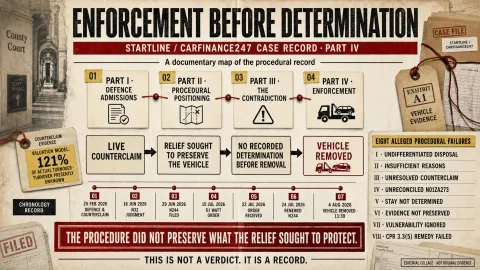
An evidence-led examination of how a delivery-of-goods judgment, a live Defence and Counterclaim, a separately issued civil claim and two urgent N244 applications culminated in the removal of disputed physical evidence before the requested stay, preservat
This disclosure examines the connected proceedings involving Startline Motor Finance, CarFinance247, Reading County Court and claims M01RG980 and N01ZA273. It documents how an N32 delivery-of-goods judgment, a live Defence and Counterclaim, and two urgent N244 applications culminated in the disputed Mazda CX-5 being removed on 4 August 2026 before …
Sources:
The disclosure is based principally on the following documentary sources:
- N32 Judgment for Delivery of Goods following the hearing on 16 June 2026.
- Order of District Judge Watt dated 15 July 2026.
- N244 application dated 29 June 2026, continuation sheets, supporting Witness Statement and Proposed Draft Order.
- Renewed N244 application dated 24 July 2026 under CPR 3.3(5), continuation sheet, supporting Witness Statement, covering letter and Proposed Draft Order.
- Pre-sealing submission to Reading County Court dated 22 June 2026.
- Signed urgent court update dated 4 August 2026 recording removal of the vehicle at approximately 1:30 pm.
- Particulars of Counterclaim dated 25 February 2026 and Startline’s Reply and Defence to Counterclaim.
- Reading County Court correspondence confirming that the Defence and Counterclaim had been placed on the court file.
- N510 notices, N215 Certificates of Service, Civil National Business Centre correspondence and postal records concerning Claim N01ZA273.
- Photographic postal evidence recording delivery and receipt of the N32 and N244 documentation.
- Published Truthfarian disclosures concerning the N32 procedural contradiction, Defence structure, DWF correspondence chronology and medical vulnerability record.
The applicable legislation, Civil Procedure Rules, Practice Directions and Convention provisions were checked against official published legal sources.
Legal Breaches Identified
The disclosure identifies eight alleged procedural failures:
- Undifferentiated disposal of distinct substantive, interim, preservatory and case-management remedies — CPR 1.1, 1.2, 1.4, 3.1, 3.3(4)–(7) and 23.6; common-law procedural fairness; Article 6 ECHR.
- Insufficient reasons addressing the protective relief extinguished — common-law duty to give sufficient reasons; CPR 23.8, CPR Part 40 and Practice Direction 40B; Article 6 ECHR.
- Failure to determine or manage the live Defence and Counterclaim — CPR 3.1, 3.1A and Part 20; Consumer Credit Act 1974, sections 90–92 and 140A–140B; Consumer Rights Act 2015, sections 9–11, 19, 23 and 24.
- Failure to reconcile Claim N01ZA273 — CPR Parts 6, 7, 10, 11, 15, 16, 23 and 26; Civil Jurisdiction and Judgments Act 1982, Schedule 4.
- Failure to determine effective interim protection before enforcement — CPR 3.1(2)(g), 25.1–25.3, 40.8A, 52.16 and Part 70; Articles 6 and 8 ECHR; Article 1 of Protocol No. 1.
- Failure to preserve the disputed vehicle as physical evidence — CPR 25.1, 31.6, 32.1 and 35.1; common-law evidential integrity and the Court’s inherent jurisdiction to protect proceedings.
- Failure to address disability, vulnerability and effective participation — CPR 1.6, 3.1A and Practice Direction 1A; Equality Act 2010, sections 6, 20, 21 and 29, subject to the Schedule 3 judicial-functions boundary; Articles 6, 8 and 14 ECHR.
- Loss of the practical effectiveness of the CPR 3.3(5) remedy — CPR 3.3(5)–(9), 23.5–23.8, 25.1–25.3, 40.8A and 52.16; ICCPR Articles 2(3) and 14(1); CRPD Article 13.
These are alleged breaches arising from the documentary chronology and have not been finally determined by an appellate court or other competent tribunal.
Public Criminal-Threat Governance, AI-Mediated Patient Access, Voice / Accent Validation Failure, Data Execution Non-Disclosure, SaaS Dependency, Workforce Liability Displacement, and Patient-Record Risk

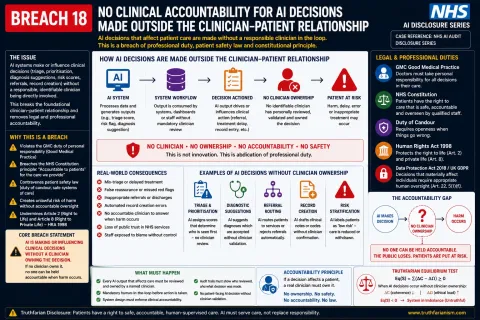
Public Criminal-Threat Governance, AI-Mediated Patient Access, Voice / Accent Validation Failure, Data Execution Non-Disclosure, SaaS Dependency, Workforce Liability Displacement, and Patient-Record Risk
This disclosure examines the concurrent deployment of AI across NHS patient access, triage, ambient voice, clinical documentation, staff workflows and cloud-based processing environments. It identifies 18 connected breach categories concerning undisclosed processing engines, data-execution location, patient consent, clinical-record integrity, accen…
Sources:
- NHS England announcements and policy publications relating to AI deployment, AI triage, ambient voice technology, NHS App integration, Single Patient Record and NHS transformation programmes.
- NHS England guidance on the use of AI-enabled ambient scribing products in health and care settings.
- NHS England / NHS Digital guidance on artificial intelligence, information governance, clinical safety and patient data processing.
- DCB0129 – Clinical Risk Management: Application in the Manufacture of Health IT Systems.
- DCB0160 – Clinical Risk Management: Application in the Deployment and Use of Health IT Systems.
- NHS AI guidance, procurement documentation, supplier information and implementation material.
- UK GDPR, Data Protection Act 2018 and common law duty of confidentiality.
- NHS Constitution, Caldicott Principles and National Data Guardian guidance.
- ICO guidance relating to AI, automated processing and data protection.
- Public statements, procurement records and published technical documentation from NHS suppliers and technology vendors where referenced.
- Parliamentary records, ministerial statements and official government publications relating to NHS AI deployment and governance where cited.
- Publicly available vendor documentation, product specifications, technical papers and implementation guidance where relied upon.
- Evidence exhibits, screenshots, correspondence, procurement documentation, system architecture diagrams and publicly accessible records reproduced or referenced throughout this disclosure.
Legal Breaches Identified
- UK GDPR (Articles 5, 6, 9, 25, 32, 35)
- Data Protection Act 2018
- Common Law Duty of Confidentiality
- NHS Constitution for England
- Caldicott Principles
- Health and Social Care Act 2012
- National Data Guardian Data Security Standards
- Equality Act 2010
- Human Rights Act 1998
- UK General Law of Public Administration (lawfulness, procedural fairness, rationality)
- Public Sector Equality Duty (Equality Act 2010, s.149)
- AI Governance and Algorithmic Accountability
- Medical Data Sovereignty
- Information Governance Requirements (NHS)
- Data Security and Protection Toolkit (DSPT)
- DCB0129 – Clinical Risk Management: Manufacturer of Health IT Systems
- DCB0160 – Clinical Risk Management: Deployment and Use in the NHS
- Cyber Security and Network Information Systems (where applicable)
- Procurement Act / Public Procurement Principles (where procurement and SaaS governance are in issue)
- Regulatory Accountability (ICO, CQC, MHRA where relevant)
- UN Convention on the Rights of Persons with Disabilities (CRPD)
- International Covenant on Civil and Political Rights (ICCPR)
- European Convention on Human Rights (where engaged)
- UNESCO Recommendation on the Ethics of Artificial Intelligence
- EU AI Act (where cross-border AI governance or providers are relevant)
Startline Motor Finance Ltd and CarFinance247 – Procedural Contradiction Between CMO / Directions Listing and N32 Judgment for Delivery of Goods, Premises-Entry Permission, and Finance-Chain Disclosure

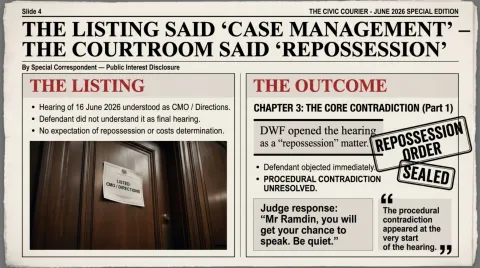

Defective-vehicle finance, DWF narrowing, protected-goods enforcement, and N32 delivery-of-goods / premises-entry disclosure.
This disclosure relies on the Startline / CarFinance247 defence-structure disclosure, the DWF correspondence and hearing-characterisation disclosure, and the Medical Health Disclosure supporting vulnerability, Type 2 diabetes, participation impact, and health-related safeguarding issues. It also relies on the core court and litigation documents in …
Sources:
- Startline Motor Finance Ltd and CarFinance247 defence-structure disclosure
https://truthfarian.co.uk/public-disclosures-PIDA-whistleblowing/startline-motor-finance-ltd-and-carfinance-247-defence - DWF correspondence chronology, Defence to Counterclaim service, N01ZA273 positioning, and hearing-characterisation disclosure
https://truthfarian.co.uk/public-disclosures-PIDA-whistleblowing/dwf-correspondence-chronology-defence-counterclaim-service - Medical Health Disclosure – Comprehensive Medical History with Supporting Evidence: June 2018 – December 2025
https://truthfarian.co.uk/public-disclosures-PIDA-whistleblowing/medical-health-disclosure-comprehensive-medical-history - Notice of Adjourned Hearing dated 4 March 2026
- Reading County Court letter confirming Defence and Counterclaim served / placed on file for the 16 June 2026 hearing
- Notice that Acknowledgment of Service has been filed in Claim No. N01ZA273, dated 26 March 2026
- DWF email serving Reply and Defence to Counterclaim in Claim No. M01RG980
- DWF N244 Application Notice in Claim No. N01ZA273, dated 31 March 2026
- Witness Statement of Jonathan Hall in support of DWF’s N244 application in Claim No. N01ZA273
- Draft order attached to DWF’s N244 application in Claim No. N01ZA273
- DWF email characterising the 16 June 2026 hearing as return-of-goods / possession hearing
- DWF post-hearing email circulating proposed draft order dated 17 June 2026
- N32 Judgment for Delivery of Goods received 23 June 2026
- Claimant’s Reply and Defence to Counterclaim dated 8 May 2026 / Statement of Truth dated 19 May 2026
- Defendant’s 22 June 2026 letter to Reading County Court with proof of dispatch / filing / delivery
- Vehicle diagnostic evidence
- CarFinance247 complaint correspondence
- Startline complaint / enforcement correspondence
- Crystal Collections voicemail evidence
- Startline automated voicemail evidence
- DSAR / data-subject-access material
- Vulnerability and medical evidence
- Universal Credit / financial hardship records
- Postal receipt, package-label, bundle-photograph, email-submission, and hand-delivery evidence
- Finance-chain records sought from Startline, CarFinance247, DWF, J.P. Morgan, NatWest, Coutts, and related institutional actors, including funding, servicing, banking, securitisation, assignment, payment-flow, underwriting, commission, recovery-agent instruction, litigation-instruction, governance, insurance, AI / automation / template-use records, and institutional-control records.
Legal Breaches Identified
- Common law natural justice
- Common law procedural fairness
- Common law right to be heard
- Common law equality of arms
- Common law open justice
- Common law duty to give sufficient reasons
- Common law duty not to mislead the Court
- Common law integrity of the Court process
- Common law evidential preservation principles
- Common law protection of the home
- Common law trespass principles
- Common law abuse-of-process jurisdiction
- Civil Procedure Rules 1998, CPR 1.1 — Overriding Objective
- Civil Procedure Rules 1998, CPR 1.3 — Duty of parties to help the Court further the Overriding Objective
- Civil Procedure Rules 1998, CPR 3.1 — Court’s general case-management powers
- Civil Procedure Rules 1998, CPR 3.3 — Court’s power to make orders of its own initiative
- Civil Procedure Rules 1998, CPR 3.4 — Strike out of statement of case
- Civil Procedure Rules 1998, CPR Part 6 — Service of documents
- Civil Procedure Rules 1998, CPR Part 7 — Commencement of proceedings
- Civil Procedure Rules 1998, CPR Part 15 — Defence and reply
- Civil Procedure Rules 1998, CPR Part 16 — Statements of case
- Civil Procedure Rules 1998, CPR Part 18 — Requests for further information and clarification
- Civil Procedure Rules 1998, CPR Part 20 — Counterclaims and additional claims
- Civil Procedure Rules 1998, CPR Part 22 — Statements of truth
- Civil Procedure Rules 1998, CPR 32.14 — False statements verified by statement of truth
- Civil Procedure Rules 1998, CPR Part 23 — Applications for Court orders
- Civil Procedure Rules 1998, CPR Part 25 — Interim remedies
- Civil Procedure Rules 1998, CPR Part 26 — Case management, allocation and directions
- Civil Procedure Rules 1998, CPR Part 31 — Disclosure and inspection of documents
- Civil Procedure Rules 1998, CPR Part 32 — Evidence
- Civil Procedure Rules 1998, CPR Part 35 — Expert evidence
- Civil Procedure Rules 1998, CPR Part 40 — Judgments and orders
- Civil Procedure Rules 1998, CPR Part 44 — General rules about costs
- Civil Procedure Rules 1998, CPR Part 45 — Fixed costs
- Civil Procedure Rules 1998, CPR Part 70 — Enforcement of judgments and orders
- Civil Procedure Rules 1998, CPR Part 83 — Writs, warrants and delivery-of-goods enforcement
- Practice Direction 1A — Vulnerable parties and witnesses
- Practice Direction 16 — Statements of case
- Practice Direction 22 — Statement-of-truth verification
- Practice Direction 23A — Applications
- Practice Direction 26 — Case management
- Practice Direction 40B — Judgments and orders
- Consumer Credit Act 1974 — Regulated consumer credit agreement framework
- Consumer Credit Act 1974, section 90 — Restriction on recovery of protected goods
- Consumer Credit Act 1974, section 91 — Consequences of breach of protected-goods recovery restrictions
- Consumer Credit Act 1974, section 92 — Recovery of protected goods from premises
- Consumer Credit Act 1974, section 129 — Time orders
- Consumer Credit Act 1974, section 140A — Unfair relationship between creditor and debtor
- Consumer Rights Act 2015, section 9 — Goods to be of satisfactory quality
- Consumer Rights Act 2015, section 10 — Goods to be fit for particular purpose
- Consumer Rights Act 2015, section 11 — Goods to be as described
- Consumer Rights Act 2015, section 19 — Consumer’s statutory rights to remedies for faulty goods
- Consumer Rights Act 2015, section 20 — Short-term right to reject
- Consumer Rights Act 2015, section 23 — Right to repair or replacement
- Financial Services and Markets Act 2000
- FCA Principles for Businesses
- FCA Consumer Credit Sourcebook (CONC)
- FCA Consumer Duty
- Equality Act 2010
- Equality Act 2010, section 6 — Disability definition
- Equality Act 2010, sections 20 and 21 — Reasonable adjustments
- Equality Act 2010, section 29 — Services and public functions
- Human Rights Act 1998, section 6 — Public-authority duty
- Human Rights Act 1998, Schedule 1, Article 6 — Right to a fair hearing
- Human Rights Act 1998, Schedule 1, Article 8 — Right to respect for private life, family life, home and correspondence
- Human Rights Act 1998, Schedule 1, Article 10 — Freedom of expression
- Data Protection Act 2018
- UK GDPR, Article 5 — Data-protection principles
- UK GDPR, Article 15 — Right of access
- UK GDPR, Article 22 — Automated decision-making safeguards
- UK GDPR accountability, fairness, transparency, accuracy, minimisation, integrity and confidentiality principles
- Protection from Harassment Act 1997
- Defamation Act 2013, section 4 — Publication on matter of public interest
- Contempt of Court Act 1981, sections 1–2 — Strict liability rule and publication risk in active proceedings
- SRA Principles 2019
- SRA Code of Conduct for Solicitors, RELs and RFLs 2019
- SRA Code of Conduct for Firms 2019
Guildford County Court – General Form of Judgment or Order Dated 6 May 2026, Disputed Hearing Notice Chronology, Separate Communication Pathways, and Continuing CNBC Divergence Concerning Claim M12ZA874
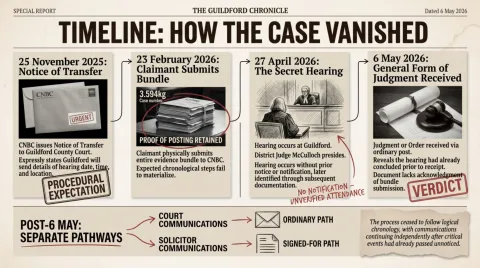
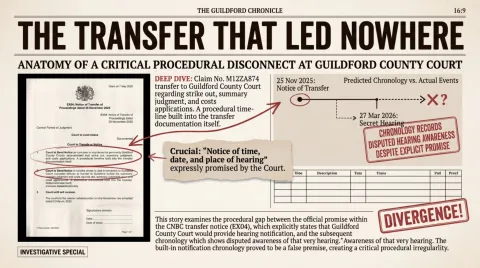
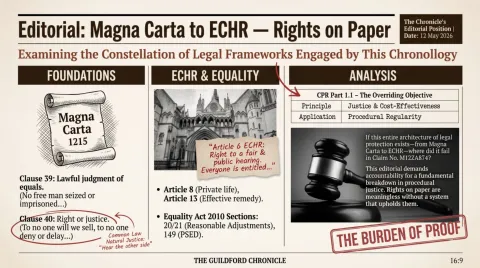
The Hearing That Wasn’t There: Transfer Chronology, Notification Failure, and Procedural Divergence at Guildford County Court
This disclosure records procedural chronology arising following transfer of Claim M12ZA874 from the Civil National Business Centre to Guildford County Court, subsequent hearing chronology dated 27 April 2026, and later order chronology recorded within the General Form of Judgment or Order dated 6 May 2026. The chronology records transfer chronology…
Sources:
• General Form of Judgment or Order dated 6 May 2026 (EX01)
• Court correspondence envelope photograph evidencing ordinary postal communication pathway chronology (EX02)
• Gordons correspondence envelope photographs evidencing ordinary letterbox delivery chronology and separate signed-for correspondence chronology including refused delivery chronology (EX03)
• Notice of Transfer of Proceedings dated 25 November 2025 evidencing transfer chronology from CNBC to Guildford County Court (EX04)
• Claim chronology relating to Claim No. M12ZA874
• CNBC submission chronology
• Guildford County Court transfer chronology
• Hearing chronology dated 27 April 2026
• District Judge McCulloch hearing chronology
• Court postal chronology
• Solicitor communication chronology
• Public HMCTS hearing listing chronology review chronology
• Communication chronology review including telephone, voicemail, SMS, email, and hearing notification chronology
• Postal chronology concerning ordinary and signed-for correspondence pathways
• Procedural chronology concerning service, participation, notification, transfer, and outcome pathways
• Claimant chronology notes and contemporaneous records concerning hearing awareness chronology and communication chronology
Legal Breaches Identified
I. Failure to provide identified hearing notification chronology
II. Failure to provide identified hearing visibility chronology
III. Failure to provide identified public HMCTS listing chronology
IV. Failure to provide identified participation chronology prior to hearing chronology
V. Failure to provide identified locality verification chronology prior to Guildford pathway chronology
VI. Failure to provide identified venue suitability chronology
VII. Failure to provide identified communication chronology before hearing chronology
VIII. Failure to provide identified telephone chronology
IX. Failure to provide identified missed-call chronology
X. Failure to provide identified voicemail chronology
XI. Failure to provide identified SMS chronology
XII. Failure to provide identified email notification chronology
XIII. Procedural divergence between transfer chronology and later hearing chronology
XIV. Divergence between anticipated hearing notification chronology and later hearing awareness chronology
XV. Hearing chronology emerging through later order chronology rather than pre-hearing notification chronology
XVI. Communication pathway fragmentation between court chronology and solicitor chronology
XVII. Parallel communication pathway chronology creating procedural inconsistency
XVIII. Potential failure to provide reasonable adjustments chronology
XIX. Potential failure to account for vulnerability chronology within hearing pathway chronology
XX. Potential participation disadvantage chronology
XXI. Potential procedural fairness chronology failure
XXII. Potential access to justice chronology failure
XXIII. Potential equal participation chronology failure
XXIV. Potential hearing accessibility chronology failure
XXV. Procedural irregularity chronology concerning transfer-to-hearing pathway chronology
XXVI. Service chronology conflict arising from invalid service findings and later order chronology
XXVII. Costs chronology arising following disputed hearing awareness chronology
XXVIII. Divergence between court postal chronology and notification chronology
XXIX. Procedural fragmentation between submission chronology and hearing chronology
XXX. Breakdown in chronological continuity between transfer, notification, participation, and outcome pathways
DWF Correspondence Chronology, Defence to Counterclaim Service, Civil Claim Positioning, and Hearing Characterisation Following Multi-Track Litigation Escalation
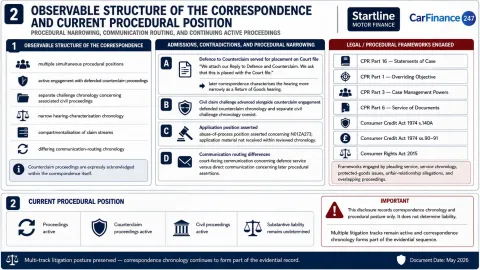
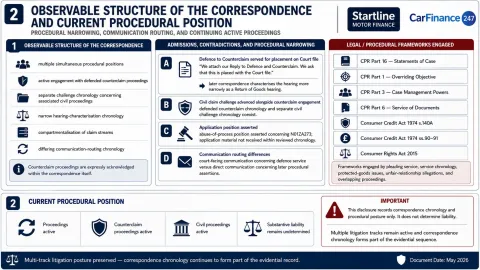
Defence to Counterclaim Service, Procedural Narrowing, and Hearing Characterisation Across Parallel Proceedings
This disclosure records correspondence chronology emerging following service of the Defence to Counterclaim in Claim No. M01RG980 together with subsequent procedural communications concerning associated civil proceedings in Claim No. N01ZA273. The disclosure concerns service chronology, hearing-characterisation chronology, civil claim chronology, a…
Sources:
I. DWF correspondence dated 19 May 2026 concerning service of the Reply and Defence to Counterclaim (Claim No. M01RG980)
II. Claimant correspondence dated 20 May 2026 concerning counterclaim chronology, civil claim chronology, and hearing-position chronology
III. Subsequent DWF correspondence concerning Return of Goods hearing characterisation
IV. Correspondence chronology concerning asserted abuse-of-process position relating to Claim No. N01ZA273
V. Claim No. M01RG980 pleadings chronology including Defence, Counterclaim, Reply, and Defence to Counterclaim chronology
VI. Claim No. N01ZA273 civil claim chronology and associated procedural correspondence
VII. Protected-goods chronology and associated enforcement chronology already pleaded within the wider proceedings
VIII. Complaint chronology and escalation chronology previously disclosed
IX. DSAR chronology and associated correspondence chronology previously disclosed
X. Vulnerability chronology and associated disclosure chronology previously pleaded
XI. Residential attendance chronology including enforcement attendance chronology previously disclosed
XII. Existing disclosure set and supporting exhibits already incorporated within the wider litigation chronology
Legal Breaches Identified
I. Procedural Narrowing Chronology
II. Hearing Characterisation Inconsistency Chronology
III. Counterclaim Engagement While Narrowing Proceedings Chronology
IV. Communication Routing Differences Chronology
V. Civil Claim Non-Engagement Chronology (N01ZA273)
VI. Asserted Application Position Without Corresponding Material Received Chronology
VII. Continuing Procedural Overlap Across Parallel Proceedings
VIII. Service and Notification Chronology Concerns
IX. Continuing Quantum and Amendment Chronology
Startline Motor Finance Ltd and CarFinance 247 – Defence Structure, Procedural Narrowing, and Non-Engagement with Pleaded Breach Chronology Following Service of the Counterclaim
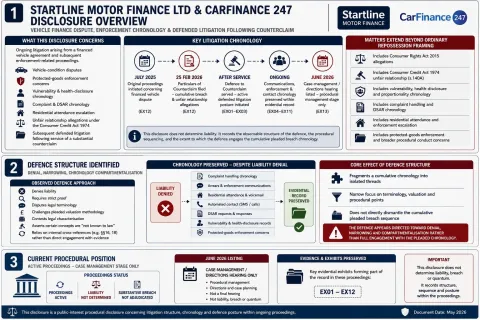
Defence posture, protected-goods admissions, and procedural narrowing in Startline / CarFinance 247 litigation following service of counterclaim.
This disclosure records the procedural posture of Startline Motor Finance Ltd and CarFinance 247 following service of the counterclaim.It identifies a defence structure centred on denial, procedural narrowing, semantic challenge, protected-goods admissions, diagnostic contradictions, vulnerability avoidance, and limited engagement with the cumulati…
Sources:
I. Reply and Defence to Counterclaim
II. Counterclaim Proceedings Hearing Notice
III. Filed Particulars of Counterclaim
IV. DWF Litigation Communications
V. Startline Motor Finance Communications
VI. CarFinance 247 Communications
VII. Crystal Collections Communications
VIII. Startline SMS Communications
IX. Residential Attendance and Enforcement Timeline
X. Crystal Collections Voicemail Transcript
XI. Startline Automated Voicemail Transcript
Legal Breaches Identified
I. CPR Part 16 — Statements of Case
II. CPR Part 1 — Overriding Objective
III. Consumer Credit Act 1974 — Section 140A
IV. CPR Part 3 — Case Management Powers
NHS/Palantir Unlimited Access to Identifiable Patient Data – Fundamental Human Rights, Medical Sovereignty, and Confidentiality Framework Breach Concerning NHS England, the Federated Data Platform (FDP), and the National Data Integration Tenant (NDIT)

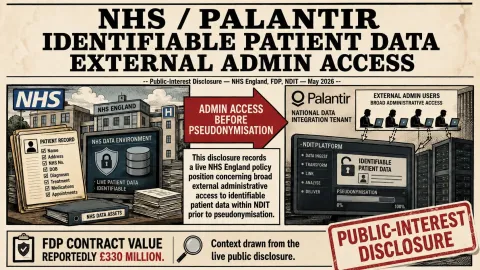
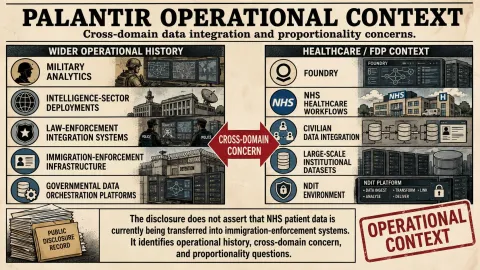
Live NHS England policy permitting broad external administrative access to identifiable patient medical data prior to pseudonymisation processing, engaging medical sovereignty, confidentiality, proportionality, and human-rights framework concerns.
This disclosure records the confirmed NHS England policy position permitting broad external administrative access to identifiable patient data within the National Data Integration Tenant (NDIT), operating inside the £330 million Federated Data Platform (FDP) infrastructure involving Palantir Technologies and external contractors. The disclosure ide…
Sources:
- Reuters — NHS England granting Palantir/external contractors broad administrative access to identifiable patient data
https://www.reuters.com/world/uk/britains-nhs-grant-palantir-contractors-unlimited-access-patient-data-ft-reports-2026-05-11/ - Financial Times — “Unlimited access” admin roles and NDIT pre-pseudonymisation environment
https://www.ft.com/content/8ce1b9be-1d51-466b-90de-54bff1a504ca - The Guardian — NHS single patient record integration and identifiable data concerns
https://www.theguardian.com/society/2026/may/10/gps-and-hospitals-in-england-to-be-required-to-share-data-to-create-single-patient-records - Digital Health — Internal NHS briefing and external admin-access structures
https://www.digitalhealth.net/2026/05/palantir-to-be-granted-unlimited-access-to-nhs-patient-data/ - Computing.co.uk — Identifiable patient-data access prior to pseudonymisation
https://www.computing.co.uk/news/2026/government/nhs-palantir-access-to-identifiable-patient-data - NHS England — Federated Data Platform contract explainer
https://www.england.nhs.uk/digitaltechnology/nhs-federated-data-platform/security-privacy/contract-explainer/ - NHS England — FDP FAQ and operational architecture
https://www.england.nhs.uk/digitaltechnology/nhs-federated-data-platform/fdp-faqs/
Legal Breaches Identified
I. UK GDPR Article 5(1)(a) — Lawfulness, Fairness, Transparency
“Personal data shall be:
processed lawfully, fairly and in a transparent manner in relation to the data subject.”
II. UK GDPR Article 5(1)(c) — Data Minimisation
“Personal data shall be:
adequate, relevant and limited to what is necessary in relation to the purposes for which they are processed.”
III. UK GDPR Article 5(1)(f) — Integrity and Confidentiality
“Personal data shall be:
processed in a manner that ensures appropriate security of the personal data, including protection against unauthorised or unlawful processing…”
IV. UK GDPR Article 6(1) — Lawful Basis
“Processing shall be lawful only if and to the extent that at least one of the following applies…”
“processing is necessary for the performance of a task carried out in the public interest or in the exercise of official authority vested in the controller.”
V. UK GDPR Article 9(1) — Special Category Health Data
“Processing of personal data revealing racial or ethnic origin, political opinions, religious or philosophical beliefs… genetic data, biometric data… or data concerning health shall be prohibited…”
VI. Data Protection Act 2018
“The processing of personal data to which this Chapter applies is lawful under Article 6(1)(e) of the GDPR… if it is necessary for the exercise of a function…”
VII. Common Law Duty of Confidentiality
“The doctor is under a duty not to disclose, without the consent of the patient, information which he, the doctor, has gained in his professional capacity…”
Hunter v Mann
VIII. ECHR Article 8 — Right to Private Life
“Everyone has the right to respect for his private and family life, his home and his correspondence.”
IX. NHS Constitution — Privacy and Confidentiality Rights
“You have the right to privacy and confidentiality and to expect the NHS to keep your confidential information safe and secure.”
X. UDHR Article 12
“No one shall be subjected to arbitrary interference with his privacy, family, home or correspondence…”
XI. ICCPR Article 17
“No one shall be subjected to arbitrary or unlawful interference with his privacy…”
XII. Convention 108+
“Special categories of data may only be processed where appropriate safeguards are enshrined in law…”
XIII. UNESCO Universal Declaration on Bioethics and Human Rights — Article 9
“The privacy of the persons concerned and the confidentiality of their personal information should be respected.”
XIV. Nuremberg Principle of Voluntary Consent
“The voluntary consent of the human subject is absolutely essential.”
XV. OECD Privacy Guidelines
“There should be limits to the collection of personal data and any such data should be obtained by lawful and fair means…”
XVI. UN Guiding Principles on Business and Human Rights
“Business enterprises should respect human rights. This means that they should avoid infringing on the human rights of others…”
Proof of Usefulness operated by HackerNoon.com – Response to Legal Notice, Direction to Inactive Legal Email, and Continuing Publication After Notice
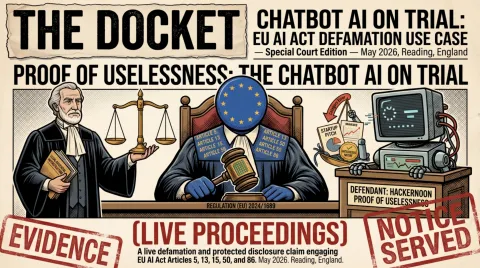
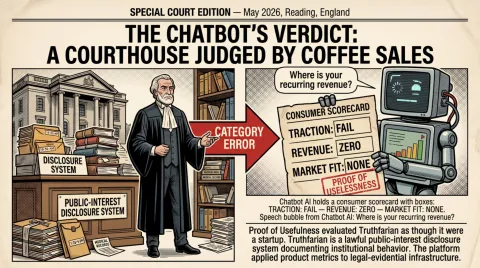
This disclosure records the response to formal legal notice, the direction to an inactive legal address, and the continuing live publication of false and damaging material.
This disclosure records the response sequence adopted by Proof of Usefulness, operated under HackerNoon.com, after formal legal notice was given concerning the live publication about Truthfarian. It records that notice was sent through multiple channels, receipt was later acknowledged, further correspondence was directed to legal@hackernoon.com, an…
Sources:
* Proof of Usefulness publication page
* Truthfarian disclosure record
* 30 April 2026 formal email correspondence
* Delivery notifications to company-linked email addresses
* 4 May 2026 LinkedIn direct message notice
* 12 May 2026 HackerNoon direct message acknowledgment
* 13 May 2026 inactive legal email bounce report
* LinkedIn direct message thread showing attachment of four formal PDFs
* Public LinkedIn thread notice screenshots
* Screenshots of later LinkedIn thread viewing states
Legal Breaches Identified
I. Media and Communications Pre-Action Protocol — Good Faith Early Resolution
II. Media and Communications Pre-Action Protocol — Time-Sensitive Publication Context
III. General Pre-Action Conduct — Steps Expected Before Proceedings
IV. Service / Notice Context
V. UK GDPR Accuracy Principle
VI. UK GDPR Right to Rectification
VII. UK GDPR Right to Erasure
VIII. UK GDPR Lawfulness, Fairness and Transparency Context
IX. Continuing Publication After Acknowledgment
X. Administrative Burden and Lawful Redress Pathway
Employment Tribunal — Rule 28(1) Initial Consideration, Procedural Pressure, Equality-of-Arms Concerns, and Subsequent Procedural Continuation
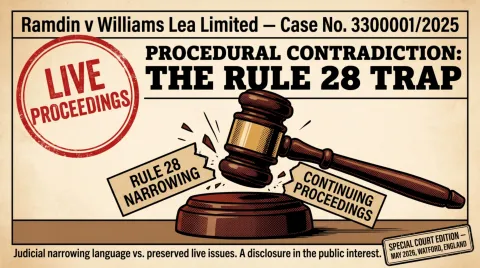
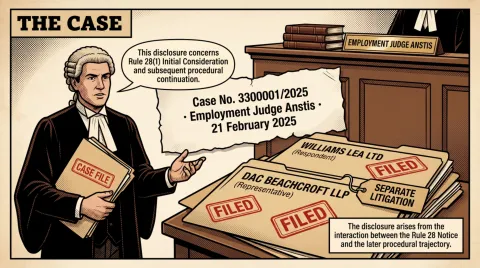
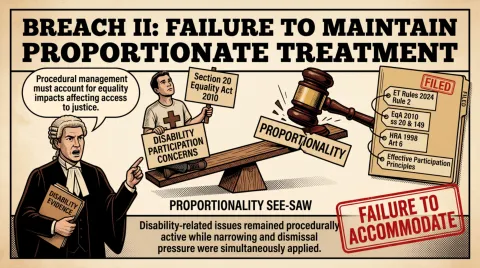
Rule 28 narrowing language preserved live overtime and disability issues while proceedings continued through settlement stages, hearing progression, accommodation delay, and retrospective procedural reinterpretation.
This disclosure concerns a Rule 28(1) Initial Consideration Notice issued within Employment Tribunal proceedings in Ramdin v Williams Lea Limited (Case No. 3300001/2025). While the Notice applied narrowing and dismissal-oriented language to parts of the claim, it simultaneously preserved overtime and disability-related issues for further determinat…
Sources:
- Employment Tribunal – Five-Month Delay in Medical Accommodation Application and Late Rule 31 Objection
- Williams Lea – Video Hearing Direction, Overtime Evidence Scope, and Procedural Posture
- Tribunal Knowledge of Medical Vulnerability and Subsequent Procedural Detriment
- Williams Lea – Unpaid Overtime, Time Equivalent Served (TES), and Health & Safety Threshold Breach
- SRA “No Case” Signal vs CNBC Continuation — Regulatory Dismissal and Continuing Procedural Escalation
Legal Breaches Identified
I. Employment Tribunal Rules of Procedure 2024 — Rule 2 (Overriding Objective)
II. Employment Tribunal Rules of Procedure 2024 — Rule 28(1) (Initial Consideration)
III. Employment Tribunal Rules of Procedure 2024 — Rule 31(2) (Applications and Service)
IV. Equality Act 2010 — Section 20 (Duty to Make Reasonable Adjustments)
V. Equality Act 2010 — Section 21 (Failure to Comply with Duty)
VI. Equality Act 2010 — Section 149 (Public Sector Equality Duty)
VII. Human Rights Act 1998 — Article 6 (Fair Hearing, Equality of Arms, and Effective Participation)
VIII. Human Rights Act 1998 — Article 8 (Private Life and Personal Integrity)
IX. ICCPR — Article 14(1) (Equality Before Courts and Tribunals)
X. UK GDPR — Article 5(1)(d) (Accuracy Principle)
XI. UK GDPR — Article 15 (Right of Access)
XII. Data Protection Act 2018
XIII. Principles of Natural Justice
XIV. Principles Against Apparent Bias
XV. Public Interest Disclosure Principles
XVI. Common Law Duty of Fair Procedure
XVII. Open Justice Principles
Reading County Court — Without Notice Directions Order Following Filed N244 Application and Ongoing Property Safety and Statutory Non-Compliance (26 March 2026)


Verified N244 filing followed by prolonged court silence, procedural non-response, and administrative drift
This disclosure records a verified N244 application bundle filed at Reading County Court on 17 March 2026 in Claim No. M04ZA309 — Ramdin v Gopal, linked to MO0RG751 possession proceedings. Following filing, no effective acknowledgement, listing, direction, sealed order, or procedural response was received within a reasonable period, leaving the app…
Sources:
- EX01 — Verified N244 Application Bundle Filed at Reading County Court (17 March 2026)
- EX02 — Physical Filing Confirmation / Court Drop-Box Submission Record (17 March 2026)
- EX03 — Claim No. M04ZA309 — Ramdin v Gopal
- EX04 — Linked Proceedings: MO0RG751 — Possession Proceedings, Reading County Court
- EX05 — Procedural Silence Timeline Following Verified Filing (17 March 2026 – Status Date)
- EX06 — Absence of Court Acknowledgement, Listing Notice, Direction, or Sealed Order
- EX07 — Defence / Counterparty Interference Context During Unresolved Court Processing
- EX08 — Landlord Safety Failure and Habitability Context Underlying the Application
- Civil Procedure Rules — Part 1, Part 3, and Part 23
- Human Rights Act 1998 — Article 6 ECHR
- Effective Remedy Principle — Article 13 ECHR / Common Law Remedy Standards
- Common Law — Natural Justice and Procedural Fairness
- HMCTS Administrative Standards and Reasonable Processing Duties
- Claimant Witness Evidence
- Court Filing and Correspondence Record
Legal Breaches Identified
I. Civil Procedure Rules — Rule 1.1 (Overriding Objective)
"These Rules are a procedural code with the overriding objective of enabling the court to deal with cases justly and at proportionate cost."
II. Civil Procedure Rules — Rule 1.2 (Court’s Duty to Give Effect to the Overriding Objective)
"The court must seek to give effect to the overriding objective when it exercises any power given to it by the Rules."
III. Civil Procedure Rules — Rule 1.4 (Court’s Duty of Active Case Management)
"The court must further the overriding objective by actively managing cases."
IV. Civil Procedure Rules — Part 23 (General Rules About Applications for Court Orders)
"An application for a court order must be made in accordance with Part 23 and supported where required by evidence."
V. Civil Procedure Rules — Rule 23.6 (Service of Application Notice)
"A copy of the application notice must be served as soon as practicable after it is filed."
VI. Civil Procedure Rules — Rule 3.1 (Court’s General Powers of Management)
"The court may extend or shorten the time for compliance, adjourn or bring forward a hearing, and make any order for the purpose of managing the case."
VII. Civil Procedure Rules — Rule 3.3 (Court’s Power to Make Orders of Its Own Initiative)
"The court may exercise its powers on an application or of its own initiative."
VIII. Human Rights Act 1998 — Article 6 ECHR (Right to a Fair Hearing)
"Everyone is entitled to a fair and public hearing within a reasonable time by an independent and impartial tribunal established by law."
IX. Human Rights Act 1998 — Article 13 ECHR / Effective Remedy Principle
"Where procedural rights are engaged, the remedy must be practical and effective, not merely theoretical or illusory."
X. Common Law — Natural Justice (Audi Alteram Partem)
"No person should be procedurally disadvantaged without a fair opportunity to be heard and to have their filed application considered."
XI. Common Law — Duty of Procedural Fairness
"Public decision-makers and court administration must act fairly, consistently, and without unexplained procedural obstruction."
XII. HMCTS Administrative Standards — Reasonable Processing and Response
"Court administration must process verified filings within a reasonable time and maintain procedural integrity where applications affect live rights and remedies."
Reading County Court — 31-Day Non-Response to Verified N244 Filing (Procedural Silence Event)
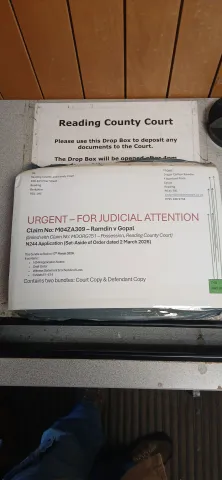
37 days after verified N244 filing, Reading County Court has issued no acknowledgment, listing, or procedural response.
A complete N244 application bundle was physically delivered to Reading County Court on 17 March 2026 via the court document drop box, evidenced photographically and identifying Claim No. M04ZA309 and the linked possession proceedings. HMCTS guidance states that most N244 applications require a hearing and that the court will allocate a hearing date…
Sources:
- EX01 — Photographic Evidence of N244 Filing (17 March 2026)
- EX02 — Court Drop Box Deposit Confirmation Images
- EX03 — N244 Application Bundle (Filed Documents)
- EX04 — Draft Order Submitted with Application
- EX05 — Witness Statement and Exhibits
- EX06 — Timeline Record (17 March – 23 April 2026)
- Civil Procedure Rules Part 23 (Applications)
- Civil Procedure Rules r.1.1 (Overriding Objective)
- Practice Direction 1A (Participation of Vulnerable Parties)
- Human Rights Act 1998 – Article 6 ECHR
- HMCTS N244 Guidance (Hearing Allocation Expectations)
Legal Breaches Identified
I. Civil Procedure Rules — Part 23 (Applications)
"This Part sets out the general rules about applications for court orders."
II. Civil Procedure Rules — Rule 1.1 (Overriding Objective)
"These Rules are a procedural code… enabling the court to deal with cases justly and at proportionate cost."
III. Practice Direction 1A — Participation of Vulnerable Parties
"The court should ensure that parties can participate fully in proceedings."
IV. Human Rights Act 1998 — Article 6
"Everyone is entitled to a fair hearing within a reasonable time."
V. HMCTS Guidance — N244 Applications
"Most applications will require a hearing and the court will allocate a hearing date and time."
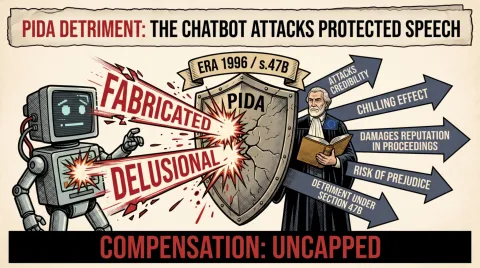
Proof of Usefulness (operated by HackerNoon.com) – False Public Characterisation, Defamatory Imputation, Inaccurate Data Processing, Protected Disclosure Detriment, and EU AI Act Transparency / Accountability Concerns Concerning Truthfarian

False classification of a legal disclosure system as a consumer product leading to defamatory imputation, data inaccuracy, and ongoing reputational harm.
This disclosure records a materially false public evaluation of Truthfarian published through Proof of Usefulness, operated under HackerNoon. A consumer-product scoring model was applied to a lawful public-interest, evidential, legal, doctrinal, and analytical system, producing statements such as “pseudo-legal,” “entirely unsupported by empirical e…
Sources:
- EX01 — Proof of Usefulness Report – Truthfarian (Live Publication)
- EX02 — Proof of Usefulness Report – Truthfarian (Screenshot / Capture)
- EX03 — Truthfarian Platform (truthfarian.co.uk) — Public Disclosures and Source Material
- EX04 — Tribunal Knowledge of Medical Vulnerability and Subsequent Procedural Detriment
- EX05 — DAC Beachcroft LLP — Procedural Interference and Intimidation
- EX06 — Reading County Court — Suppression and Procedural Breach
- EX07 — Introduction of a January Hearing Date by Party Email and Subsequent Retrospective Correspondence
- Disparity Mapping — Description vs Defendant Summary (Truthfarian vs Published Evaluation)
- Defamation Act 2013
- UK GDPR and Data Protection Act 2018
- Employment Rights Act 1996, section 47B (PIDA 1998)
- Human Rights Act 1998 and ECHR Articles 6, 8 and 10
- Fraud Act 2006, Section 2
- Claimant Witness Evidence and Procedural Record
- Regulation (EU) 2024/1689 — EU Artificial Intelligence Act (Official Text / EUR-Lex)
- European Commission — AI Act / Transparency Guidance
- EU AI Act Explorer / Documentation Site (reference aid only)
Legal Breaches Identified
I. Defamation Act 2013 — Section 1 (Serious Harm)
"A statement is not defamatory unless its publication has caused or is likely to cause serious harm to the reputation of the claimant."
II. Defamation Act 2013 — Section 2 (Truth Defence)
"It is a defence to an action for defamation for the defendant to show that the imputation conveyed by the statement complained of is substantially true."
III. Defamation Act 2013 — Section 3 (Honest Opinion)
"It is a defence… if the statement complained of was a statement of opinion… indicated the basis of the opinion… and an honest person could have held the opinion on the basis of any fact which existed at the time."
IV. Defamation Act 2013 — Section 4 (Publication on Matter of Public Interest)
"It is a defence… if the defendant shows that the statement complained of was… on a matter of public interest, and… the defendant reasonably believed that publishing the statement complained of was in the public interest."
V. Defamation Act 2013 — Section 5 (Operators of Websites)
"It is a defence… if the operator shows that it was not the operator who posted the statement… subject to compliance with the notice of complaint procedure."
VI. Common Law — Malicious Falsehood / Injurious Falsehood
"Publication of false statements made maliciously, causing damage to economic or reputational interests."
VII. Common Law — Defamation by Misleading Omission
"A statement may be defamatory where, by omission, it creates a false or misleading impression."
VIII. Common Law — Negligent / Irresponsible Publication
"Liability arises where publication occurs without reasonable care as to accuracy or verification."
IX. UK GDPR — Article 5(1)(d) (Accuracy Principle)
"Personal data shall be… accurate and, where necessary, kept up to date… every reasonable step must be taken to ensure that personal data that are inaccurate… are erased or rectified without delay."
X. UK GDPR — Article 16 (Right to Rectification)
"The data subject shall have the right to obtain… the rectification of inaccurate personal data concerning him or her without undue delay."
XI. UK GDPR — Article 17 (Right to Erasure)
"The data subject shall have the right to obtain… the erasure of personal data… where the personal data are no longer necessary… or have been unlawfully processed."
XII. Data Protection Act 2018
"Provides enforcement of UK GDPR obligations within domestic law."
XIII. Common Law — Unlawful Interference with Economic Relations
"Liability arises where unlawful means are used to interfere with business or economic interests."
XIV. Common Law — Aggravated Damages (Defamation)
"Damages may be increased where conduct aggravates injury, including persistence after notice."
XV. Equitable Principles — Injunctive Relief
"Courts may grant injunctions to restrain ongoing or repeated wrongful publication."
XVI. European Convention on Human Rights — Article 8
"Everyone has the right to respect for his private and family life, his home and his correspondence."
XVII. European Convention on Human Rights — Article 10
"Everyone has the right to freedom of expression… subject to… restrictions… for the protection of the reputation or rights of others."
XVIII. European Convention on Human Rights — Article 6
"In the determination of his civil rights and obligations… everyone is entitled to a fair… hearing…"
XIX. Human Rights Act 1998
"So far as it is possible to do so, primary legislation and subordinate legislation must be read and given effect in a way which is compatible with the Convention rights."
XX. International Covenant on Civil and Political Rights — Article 17
"No one shall be subjected to arbitrary or unlawful interference with his privacy… nor to unlawful attacks on his honour and reputation."
XXI. International Covenant on Civil and Political Rights — Article 19
"Everyone shall have the right to hold opinions… and to freedom of expression… subject to… respect of the rights or reputations of others."
XXII. UN Guiding Principles on Business and Human Rights — Principle 11
"Business enterprises should respect human rights."
XXIII. UN Guiding Principles on Business and Human Rights — Principle 13
"Business enterprises should avoid causing or contributing to adverse human rights impacts through their own activities…"
XXIV. Universal Declaration of Human Rights — Article 12
"No one shall be subjected to arbitrary interference with his privacy… nor to attacks upon his honour and reputation."
XXV. Universal Declaration of Human Rights — Article 19
"Everyone has the right to freedom of opinion and expression…"
XXVI. Equality Act 2010 — Section 29 (conditional)
"A person must not discriminate in the provision of a service…"
XXVII. Protection from Harassment Act 1997 — Section 1 (threshold dependent)
"A person must not pursue a course of conduct which amounts to harassment…"
XXVIII. Fraud Act 2006 — Section 2 (False Representation)
"A person is in breach if he dishonestly makes a false representation… intending to make a gain… or to cause loss… or expose another to a risk of loss."
XXIX. Employment Rights Act 1996 — Section 47B (as inserted by PIDA 1998) — Detriment for Protected Disclosure
"A worker has the right not to be subjected to any detriment by any act, or any deliberate failure to act, done on the ground that the worker has made a protected disclosure."
XXIX. European Union AI Act — Article 50 (Transparency Obligations for AI-Generated Content)
"Providers and deployers of certain AI systems must ensure appropriate transparency for AI-generated or AI-manipulated content, including marking or labelling certain AI-generated content and certain AI-generated text published on matters of public interest."
XXX. European Union AI Act — Article 13 (Transparency and Provision of Information)
"Providers of AI systems must ensure that the operation of those systems is sufficiently transparent to enable deployers to interpret outputs and use them appropriately."
XXXI. European Union AI Act — Article 15 (Accuracy, Robustness and Cybersecurity)
"AI systems shall be designed and developed in such a way that they achieve an appropriate level of accuracy, robustness and consistency of performance throughout their lifecycle."
XXXII. European Union AI Act — Article 5 (Prohibited Artificial Intelligence Practices)
"AI practices that deploy subliminal techniques, exploit vulnerabilities, or are used in ways that cause harm to persons through deception or manipulation are prohibited."
XXXIII. European Union AI Act — Article 86 (Right to an Explanation of Individual Decision-Making)
"A person affected by a decision taken on the basis of the output of a high-risk AI system, where that decision produces legal effects or similarly significantly affects that person’s health, safety, or fundamental rights, is entitled to a clear and meaningful explanation of the role of the AI system in that decision."
XXXIV. Employment Rights Act 1996 — Section 47B (as inserted by PIDA 1998) — Detriment for Protected Disclosure
"A worker has the right not to be subjected to any detriment by any act, or any deliberate failure to act, done on the ground that the worker has made a protected disclosure."
XXIX. Employment Rights Act 1996 — Section 47B (as inserted by PIDA 1998) — Detriment for Protected Disclosure
"A worker has the right not to be subjected to any detriment by any act, or any deliberate failure to act, done on the ground that the worker has made a protected disclosure."
XXX. European Union AI Act — Article 50 (Transparency Obligations for AI-Generated Content)
"Providers and deployers of certain AI systems must ensure appropriate transparency for AI-generated or AI-manipulated content, including marking or labelling certain AI-generated content and certain AI-generated text published on matters of public interest."
XXXI. European Union AI Act — Article 13 (Transparency and Provision of Information)
"Providers of AI systems must ensure that the operation of those systems is sufficiently transparent to enable deployers to interpret outputs and use them appropriately."
XXXII. European Union AI Act — Article 15 (Accuracy, Robustness and Cybersecurity)
"AI systems shall be designed and developed in such a way that they achieve an appropriate level of accuracy, robustness and consistency of performance throughout their lifecycle."
XXXIII. European Union AI Act — Article 5 (Prohibited Artificial Intelligence Practices)
"AI practices that deploy subliminal techniques, exploit vulnerabilities, or are used in ways that cause harm to persons through deception or manipulation are prohibited."
XXXIV. European Union AI Act — Article 86 (Right to an Explanation of Individual Decision-Making)
"A person affected by a decision taken on the basis of the output of a high-risk AI system, where that decision produces legal effects or similarly significantly affects that person’s health, safety, or fundamental rights, is entitled to a clear and meaningful explanation of the role of the AI system in that decision."
XXXV. Digital Services Act (DSA)
"The Digital Services Act introduces EU-wide rules for intermediary services and online platforms, including transparency, accountability, notice-and-action, and complaint-handling obligations in relation to online content."
XXXVI. General-Purpose AI (GPAI) Code of Practice
"The GPAI Code of Practice supports compliance obligations for providers of general-purpose AI models, including transparency, documentation, safety, and accountability measures."
XXXVII. EU Data Act
"The Data Act establishes rules on fair access to and use of data generated in the European Union, with the objective of ensuring fairness in the allocation of value from data and fair treatment in data use."
XXXVIII. Revised Product Liability Directive
"The revised Product Liability Directive modernises liability rules for defective products, including software and certain digital products, where defective outputs or functions cause harm."
XXXIX. Digital Fairness Act (emerging / forward-looking framework)
"The Digital Fairness Act is an emerging European framework directed to unfair digital commercial practices, including manipulative design, misleading digital practices, and unfair monetised online architectures."
Employment Tribunal — Five-Month Delay in Medical Accommodation Application and Late Rule 31 Objection
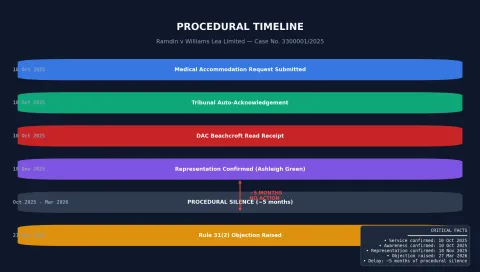
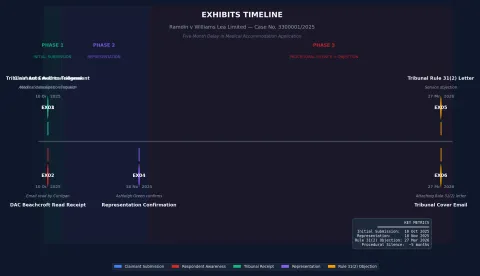
Five-month tribunal silence following medical vulnerability notification, culminating in retrospective procedural objection and compounded participation prejudice.
This disclosure records direct solicitor engagement by Gordons Partnership Solicitors LLP during a pending claim issue period following submission of a complete claim bundle to the Civil National Business Centre on 23 February 2026.Recorded delivery attempts on 17 February 2026 and 27 February 2026 were followed by a hand-delivery attempt on 26 Mar…
Sources:
Disclosure Sources
- EX01 — Claimant Email to Tribunal (10 October 2025)
- EX02 — Tribunal Acknowledgement (10 October 2025)
- EX03 — Respondent Read Receipt (10 October 2025)
- EX04 — Representation Confirmation (18 November 2025)
- EX05 — Tribunal Correspondence (27 March 2026)
- EX06 — Representation Reaffirmed (30 March 2026)
- EX07 — Procedural Silence Timeline (October 2025 – March 2026)
- Employment Tribunal Rules of Procedure 2013
- Equality Act 2010
- Human Rights Act 1998
- Common Law — Natural Justice Principles
- Claimant Witness Evidence
- Tribunal Correspondence Record
Legal Breaches Identified
Legal Frameworks
I. Employment Tribunal Rules of Procedure 2013 — Rule 2 (Overriding Objective)
"The overriding objective of these Rules is to enable Employment Tribunals to deal with cases fairly and justly."
II. Employment Tribunal Rules of Procedure 2013 — Rule 31(2)
"An application must be copied to all other parties."
III. Equality Act 2010 — Section 20 (Reasonable Adjustments)
"Where a disabled person is placed at a substantial disadvantage… reasonable steps must be taken to avoid the disadvantage."
IV. Equality Act 2010 — Section 21 (Failure to Make Adjustments)
"A failure to comply with the duty to make reasonable adjustments constitutes discrimination."
V. Equality Act 2010 — Section 149 (Public Sector Equality Duty)
"A public authority must have due regard to the need to eliminate discrimination and advance equality of opportunity."
VI. Human Rights Act 1998 — Article 6
"Everyone is entitled to a fair and public hearing within a reasonable time."
VII. Human Rights Act 1998 — Article 13
"Everyone whose rights and freedoms are violated shall have an effective remedy."
VIII. Common Law — Natural Justice (Audi Alteram Partem)
"No person should be judged without a fair opportunity to present their case."
IX. Common Law — Duty of Procedural Fairness
"Public decision-makers must act fairly and without bias."
X. Employment Tribunal Case Management Powers
"The Tribunal may regulate its own procedure to ensure fairness and justice."
Gordons Partnership Solicitors LLP – Pending CNBC Bundle Submission and Procedural Divergence
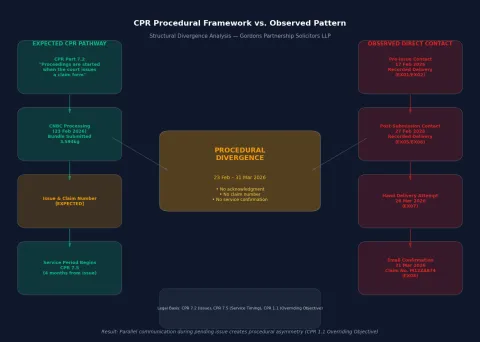
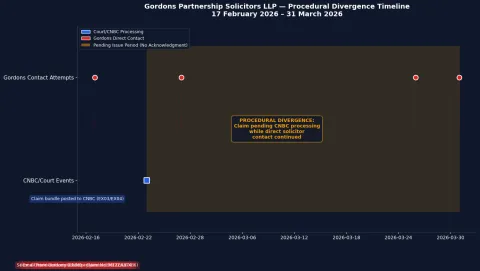

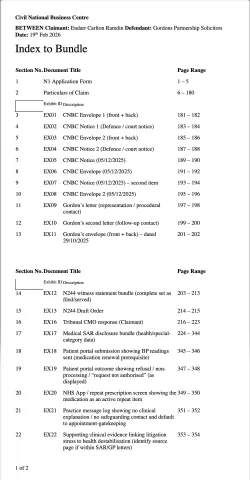
Direct solicitor contact during pending court issue period creates procedural divergence and parallel litigation pathway outside CPR framework.
This disclosure records direct solicitor contact by Gordons Partnership Solicitors LLP during a pending claim issue period following submission of a complete claim bundle to the Civil National Business Centre on 23 February 2026.Recorded delivery attempts occurred on 17 February 2026 and 27 February 2026, followed by a hand-delivery attempt on 26 M…
Sources:
Disclosure Sources
- EX01–EX07 Photographic Evidence
- EX08 Email Correspondence (31 March 2026)
- Post Office Receipt — Claim Bundle Submission (23 February 2026)
- Claimant Witness Statement
- Recorded Delivery Envelopes — Gordons Partnership Solicitors LLP
- Hand Delivery Attempt — 26 March 2026
- Email Correspondence — Gordons Partnership Solicitors LLP
- Civil Procedure Rules
- Public Interest Disclosure Act 1998
- Human Rights Act 1998
- Equality Act 2010
Legal Breaches Identified
I. Civil Procedure Rules – Practice Direction 5A, Paragraph 5.4
"A document is filed when it is delivered to the court office."
II. Civil Procedure Rules – Part 7 Rule 7.2
"Proceedings are started when the court issues a claim form."
III. Civil Procedure Rules – Part 7 Rule 7.5
"Where the claim form is to be served within the jurisdiction, the claimant must complete the step required… within four months after the date of issue."
IV. Civil Procedure Rules – Part 6 Rule 6.3
"A document may be served by any of the following methods…"
V. Civil Procedure Rules – Part 5 Rule 5.1
"This Part contains general provisions about… documents used in court proceedings."
VI. Civil Procedure Rules – Rule 1.1 (Overriding Objective)
"These Rules are a procedural code with the overriding objective of enabling the court to deal with cases justly and at proportionate cost."
VII. European Convention on Human Rights – Article 6
"In the determination of his civil rights and obligations… everyone is entitled to a fair hearing within a reasonable time."
VIII. Equality Act 2010 – Sections 20–21 and Section 149
"Where a provision, criterion or practice… puts a disabled person at a substantial disadvantage… reasonable steps must be taken."
IX. Public Interest Disclosure Act 1998 – Section 43A
"In this Part 'protected disclosure' means a qualifying disclosure…"
X. Common Law – Procedural Fairness (Audi Alteram Partem)
"No person should be judged without a fair opportunity to present their case."
Verified Physical Filing of N244 Application Bundle – Reading County Court Drop Box (17 March 2026 2.46pm)
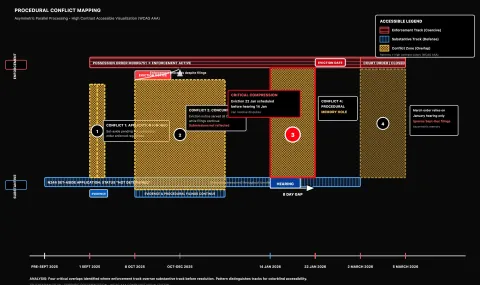
Verified physical filing, unrecorded by the court: a CPR-compliant delivery event exposing procedural divergence, record failure, and systemic administrative distortion.
This disclosure records the verified physical filing of a complete N244 application bundle at Reading County Court on 17 March 2026 via the official court drop box.The bundle was fully compliant with CPR Part 5 and Practice Direction 5A, including pagination, indexing, identification, and dual-bundle service structure. Under PD 5A para 5.4, filing …
Sources:
Disclosure Sources
- Physical N244 Application Bundle delivered to Reading County Court (17 March 2026)
- Witness Statement (200+ pages)
- Draft Order
- Exhibits E1–E14
- N181 Directions Questionnaire
- Prior filings (N244 and evidential bundles not recorded)
- Court Orders dated 29 January 2026 and 2 March 2026
- Photographic evidence of bundle preparation, packaging, and drop-box delivery
Legal Breaches Identified
I. Civil Procedure Rules — Practice Direction 5A, Paragraph 5.4
"A document is filed when it is delivered to the court office."
II. Civil Procedure Rules — Part 5
"This Part deals with the filing of documents."
III. Practice Direction 5A, Paragraph 2.2
"Documents filed must be legible and in a form suitable for the court file."
IV. Civil Procedure Rules — Part 6
"A document must be served on every other party."
V. Civil Procedure Rules — Rule 1.1 (Overriding Objective)
"These Rules are a procedural code with the overriding objective of enabling the court to deal with cases justly and at proportionate cost."
VI. European Convention on Human Rights — Article 6
"In the determination of his civil rights and obligations… everyone is entitled to a fair and public hearing…"
SRA “No Case” Signal vs CNBC Continuation — Regulatory Dismissal as Extra-Procedural Authority (DAC Beachcroft LLP)
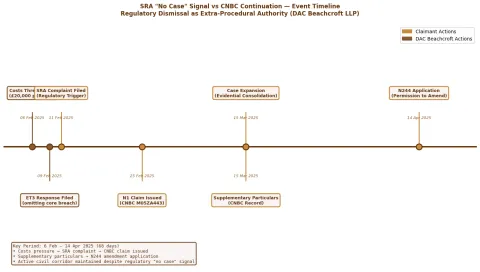
Regulatory non-enforcement deployed as simulated merits determination inside an active civil corridor.
This disclosure records a structural governance fault-line in which an SRA non-enforcement outcome (“no action” / “no case” effect) becomes operationally convertible into a proxy-merits signal while a CNBC civil claim remains live (issued claim, continuing procedure, and amendment pathway via N244). The defect recorded is not the regulator’s discre…
Sources:
1. DAC Beachcroft LLP — Costs-pressure email (WP / Save as to Costs) — 6 February 2025
2. DAC Beachcroft LLP — ET3 Response filed — 9 February 2025
3. SRA — Complaint submission (initial filing) — 11 February 2025
4. SRA — Outcome / closure communication (non-enforcement / “no case” effect) — date per file
5. Civil National Business Centre (CNBC) — N1 Claim Form issued — 25 February 2025 — Claim No. M05ZA443
6. Case file — Supplementary case expansion / breach consolidation pack — March 2025
7. CNBC — Supplementary Particulars (dated document for record) — 28 March 2025
8. CNBC — Acknowledgment of Service (N9 / AOS) — date per file
9. CNBC — N244 Application (permission to amend) — 14 April 2025
10. CNBC — N244 Cover Letter (supporting submission) — 14 April 2025
Legal Breaches Identified
Abuse of Process / Procedural Intimidation
Natural Justice / Procedural Fairness (Bias-by-Signal)
Constitutional Due Process Degradation (Magna Carta 39–40 Effect)
HRA Article 6 Interference (Fair Hearing / Equality of Arms)
HRA Article 14 Discriminatory Effect (where disability/vulnerability engaged)
Equality Act Disability Disadvantage (procedural exclusion by effect)
CPR Part 1 Corridor Integrity Failure
Service / Notice Theatre (Simulated Standing via Delivery Mechanics)
Defence / Pleading Integrity Distortion (standing asserted without compliant corridor step)
Statements of Truth / Verification Integrity Risk
Costs Weaponisation / Improper Costs Leverage
Regulatory Objectives Undermined (Legal Services Act 2007)
SRA Principles Breach (Integrity / Public Trust / Rule of Law)
SRA Code Breach (Not Misleading / Fair Dealing / Conflicts Controls)
Regulatory Signal Failure (Non-enforcement posture functioning as proxy merits verdict)
Misrepresentation Vector (False Meaning Inducement)
Harassment Vector (Course-of-Conduct Pressure)
Public Interest Disclosure Suppression / Detriment + International Interpretive Anchors
Bath Road, Hounslow, GP Surgery – Deletion of Live Patient Medical Records
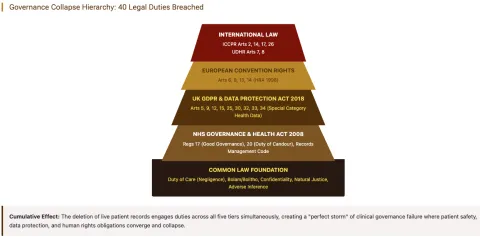
Record deletion during active care severs continuity and converts data loss into systemic clinical harm.
Deletion of live patient records triggers overlapping duties across common law, NHS governance, data protection, and human rights frameworks, creating a cumulative governance failure with direct patient-safety and accountability consequences.
Sources:
Subject Access Request (SAR) disclosure bundle — GP record output(s) evidencing missing / unavailable periods and supplied extracts.
Bath Road Surgery primary care record extracts — including the 28 June 2018 Type 2 diabetes entry (and any surrounding record context).
Patient registration / transfer record — Bath Road Surgery → Theale Medical Centre (10 May 2022 registration confirmation).
Theale Medical Centre record extracts — evidence of diabetes-care gap (May 2022–April 2024) and first diabetes-related medication review (22 April 2024).
Any SAR response letters / covering correspondence from Bath Road Surgery and/or Theale Medical Centre (including statements of what is held, what cannot be produced, and any explanations given).
Any deletion/retention notices, system notes, EMIS/TPP/SystmOne audit outputs, or explicit confirmation that no audit trail can be produced (if provided).
Clinical correspondence or secondary care letters referencing diabetes status (2018–2022) used to evidence that the diagnosis existed during the “missing” period.
Formal complaints / communications to the GP surgery regarding missing records (and any responses).
Claim documentation identifying the pleaded clinicians and defendant surgery (Particulars of Claim / N1 documents).
Correspondence from Gordons Partnership Solicitors LLP (defence/representation communications relevant to the records issue).
Any recorded-delivery envelope / postage evidence connected to Gordons correspondence (if relied upon as a disclosure source).
Any ICO / CQC submissions, reference numbers, acknowledgments, or outcomes (if already initiated and relied upon).
Legal Breaches Identified
1. Deletion and/or non-preservation of clinically material live patient medical records whilst the patient remained alive and registered.
2. Loss of auditable longitudinal continuity-of-care record (diagnosis history, treatment pathway, clinical decision-making evidence).
3. Failure to operate lawful retention and disposal governance (premature deletion and/or uncontrolled disappearance of records).
4. Failure to provide transparency, lawful justification, or documented process explaining how and why clinically material records ceased to exist.
5. Failure to produce any contemporaneous audit trail identifying the actor, timestamp, authority, mechanism, and scope of deletion/non-preservation.
6. Failure to provide remedial restoration pathway, recovery attempt evidence, or validation process capable of restoring or confirming record integrity.
7. Frustration of lawful access rights (SAR/right of access) by inability to supply clinically material personal data on request.
8. Failure of integrity and security controls sufficient to prevent loss, destruction, or unavailability of high-risk health data.
9. Failure of clinical governance systems and processes to ensure compliant record management, accountability, and oversight.
10. Failure of candour/openness in responding to a safety-critical record-integrity event and its implications for ongoing care.
11. Safeguarding and clinical risk assessment impairment arising from removal/unavailability of longitudinal history required to assess risk and manage chronic disease.
12. Interference with the patient’s ability to evidence and challenge clinical decision-making within medical, regulatory, and legal processes due to evidential destruction/unavailability.
Gordons Partnership Solicitors LLP — Unopened Correspondence Issued Post-Default
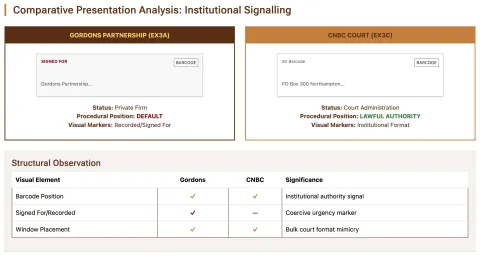
Recorded Delivery as Simulated Authority — Formal Signalling Outside the Lawful Court Corridor
This disclosure records the dispatch of a formalised recorded-delivery envelope by Gordons Partnership Solicitors LLP during a live period of Defence default. At the time of dispatch, no Defence had been filed, no relief from sanctions had been sought, and no order had restored standing. The procedural record was fixed.The envelope’s registered, au…
Sources:
Claimant correspondence sent to the County Court Business Centre (CNBC)
CNBC email correspondence and internal return notices
Gordons Partnership Solicitors LLP “Recorded Delivery” envelope (front scan)
Gordons Partnership Solicitors LLP “Recorded Delivery” envelope (rear scan)
Royal Mail tracking and delivery metadata for the Gordons envelope (09-02-26)
DAC Beachcroft LLP envelope used for comparator (EX3B)
Northampton PO Box 300 envelope used by CNBC (EX3C)
Reading County Court live case record showing Acknowledgment of Service filed
Reading County Court record showing Defence deadline expiry and default status
Civil Procedure Rules (CPR) as published on legislation.gov.uk
Human Rights Act 1998 — Articles 6 and 8 (legislation.gov.uk)
Equality Act 2010 — ss.15, 19, 20–21 (legislation.gov.uk)
Solicitors Regulation Authority (SRA) Principles 2019 (SRA official publication)
SRA Code of Conduct for Solicitors 2019 (SRA official publication)
Royal Mail delivery standards and signed-for service specification (Royal Mail publications)
HMCTS published procedural standards and response guidance (gov.uk)
Publicly available HMCTS court listing interfaces (gov.uk and CourtServe)
Claimant master bundle of indexed exhibits (as uploaded)
Time-stamped screenshots evidencing online court listing absence
Postal date stamps, delivery marks, and barcode evidence from uploaded scans
Any other evidential images uploaded as exhibits in the disclosure record
Legal Breaches Identified
I. Civil Procedure Rules — r.15.4 (Time for Filing a Defence)
II. Civil Procedure Rules — r.16.5 (Contents of the Defence)
III. Civil Procedure Rules — r.12.3 (Conditions for Default Judgment)
IV. Civil Procedure Rules — r.3.8 (Sanctions Effective Unless Relief Granted)
V. Civil Procedure Rules — r.1.3 (Duty of the Parties)
VI. Civil Procedure Rules — r.22.1 (Statement of Truth Requirement)
VII. Civil Procedure Rules — r.3.4(2)(b) (Abuse of Process)
VIII. Civil Procedure Rules — r.1.1 (Overriding Objective)
IX. Civil Procedure Rules — r.1.4 (Court’s Duty of Active Case Management)
X. Civil Procedure Rules — r.3.1 (Case Management Powers)
XI. Civil Procedure Rules — r.52.21 (Procedural Fairness / Review)
XII. Civil Procedure Rules — r.44.2 & r.44.11 (Costs and Misconduct; Personal Liability)
XIII. Human Rights Act 1998 — Article 6
XIV. Human Rights Act 1998 — Article 8
XV. Equality Act 2010 — s.15 (Discrimination Arising from Disability)
XVI. Equality Act 2010 — ss.20–21 (Reasonable Adjustments)
XVII. Equality Act 2010 — s.19 (Indirect Discrimination)
XVIII. Solicitors Regulation Authority Principles 2019
XIX. SRA Code of Conduct 2019 — para 1.2 (Misleading the Court)
XX. SRA Code of Conduct 2019 — para 1.4 (Misleading Others)
XXI. SRA Code of Conduct 2019 — para 2.7 (Threatening / Misuse of Litigation)
XXII. SRA Code of Conduct 2019 — para 7.3 (Correspondence with Opponents)
XXIII. SRA Code of Conduct 2019 — para 3.5 (Governance and Supervision)
XXIV. European Convention on Human Rights — Article 6
XXV. European Convention on Human Rights — Article 13
XXVI. International Covenant on Civil and Political Rights — Articles 2 & 14
XXVII. UN Convention on the Rights of Persons with Disabilities — Articles 5 & 13
DAC Beachcroft / CNBC (Civil National Business Centre) — Out-of-Hours Transfer Email (20 Jan 2026, 21:15) + Next-Cycle DAC Beachcroft Service Email (19 Jan 2026, 09:12): Procedural Interference Timing Pattern and Record-Integrity Risk (Claim No. M05ZA443)
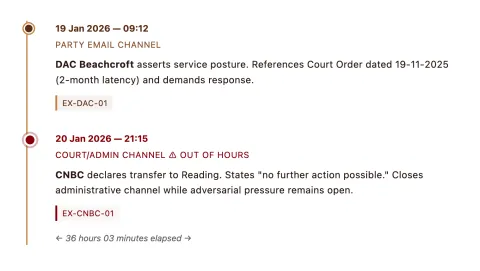
DAC Beachcroft asserted service and pressed for response, then CNBC issued an out-of-hours transfer notice closing the administrative channel creating a timing trap and record-integrity risk in M05ZA443.
DAC Beachcroft asserted service and pressed for response in Claim No. M05ZA443 while, within 36 hours, CNBC issued an out-of-hours transfer notice to Reading County Court stating it could take no action and provide no updates. The two emails operate as a single procedural sequence: adversarial momentum continues by solicitor email while the court-a…
Sources:
Procedural Interference and Intimidation During Judicial Freeze — DAC Beachcroft LLP — M05ZA443.
High-Value Claim Disposed Outside Proper Jurisdiction / Allocation — DAC Beachcroft LLP — M05ZA443.
Conflicts of Interest and Institutional Control — DAC Beachcroft LLP.
Procedural Delay, Out-of-Hours Correspondence, and Court Letter Fragmentation — CNBC / HMCTS.
Failure to Respond Within a Reasonable Time — CNBC / HMCTS.
January Hearing Date Introduced by Party Email and Retrospective Court Correspondence — HMCTS / Reading County Court.
Procedural Misstatement / Ultra Vires Commentary — Reading County Court.
Comparative Harm Valuation (PHM vs Vento Bands) — harm valuation framework.
How Ordinary People Can Use Generative AI to Clarify and Empower Their Legal Position — Legal Application Layer.
Legal Breaches Identified
Out-of-hours transfer notice (21:15) — CPR Part 6; PD 6A; HRA 1998; ECHR Art. 6.
Court-admin channel closure (“CNBC can take no action / no updates”) — CPR Part 30; PD 30; HRA 1998; ECHR Art. 6.
Transfer decision opacity (no decision time/author/reason on notice) — CPR Part 30; PD 30; common law procedural fairness; open justice.
Transfer decision-time not disclosed (audit gap) — CPR Part 30; PD 30; natural justice.
File integrity at transfer not evidenced (no inventory/baseline) — CPR Part 30; PD 30; open justice / record integrity.
Receiving court activation/receipt time not evidenced — CPR Part 30; PD 30; HRA 1998; ECHR Art. 6.
Defendant service posture asserted by email during admin closure — CPR Part 6; PD 6A; CPR Part 3.
Email “service” substitution risk (service asserted without verified court-file trail) — CPR Part 6; PD 6A; PD 5B.
Order handling latency/irregularity (order dated 19 Nov 2025 surfaced in Jan 2026 service posture) — CPR Part 40; PD 40B; CPR Part 6; PD 6A.
Proof of court service of the order not evidenced within the sequence — CPR Part 40; PD 40B; HRA 1998; ECHR Art. 6.
Tight coupling of opponent escalation and out-of-hours closure (timing trap risk) — natural justice; HRA 1998; ECHR Art. 6.
Prejudice amplification risk (“non-response/default” narrative during practical remedy window closure) — CPR Part 3; CPR Part 6; PD 6A.
Application-process integrity risk where “without a hearing” disposal is implicated on the file — CPR Part 23; PD 23A; CPR Part 3.
Anonymous/unsigned CNBC authorship despite first-person wording (“I/we”) — CPR Part 30; PD 30; open justice / record integrity; HRA 1998; ECHR Art. 6.
Judicial Order Proceeding on Assumed Hearing and Unidentified Third-Party Participation – Reading County Court (January 2026)

Procedural reliance on a hearing that was never lawfully notified, listed, or served.
This disclosure documents a procedural failure in which a January 2026 hearing was asserted and relied upon without any lawful notice, public listing, or proof of service. The only communication of the alleged hearing date originated from party correspondence, followed by delayed and retrospective court administration after the asserted date had pa…
Sources:
This disclosure is derived from the following primary and corroborative sources:
• Court correspondence and orders issued by the County Court Business Centre (CNBC) and Reading County Court, including scanned letters received post-January 2026.
• Party correspondence (email) asserting a January 2026 hearing date without any accompanying court-issued notice.
• Absence of official court records, including no sealed Notice of Hearing and no public listing on HMCTS-maintained hearing lists or CourtServe at the relevant time.
• Timestamped administrative communications, including out-of-hours correspondence issued by CNBC.
• Documentary evidence bundle submitted and logged prior to the asserted hearing date.
• Visual evidence demonstrating volume, timing, and escalation of documentation delivered to the court.
• Cross-reference to related Truthfarian disclosures, including procedural suppression and court handling irregularities at Reading County Court.
• Publicly accessible HMCTS listings and service standards, used to verify non-listing and procedural non-compliance.
Legal Breaches Identified
I. Failure to serve a sealed Notice of Hearing
II. Absence of lawful service under CPR Part 6
III. Proceeding on an assumed hearing without notice
IV. No public listing of the alleged hearing (HMCTS / CourtServe)
V. Denial of the right to attend and be heard
VI. Breach of natural justice (audi alteram partem)
VII. Equality of arms violation
VIII. Procedural ambush by retrospective correspondence
IX. Out-of-hours court communication undermining procedural fairness
X. Excessive administrative delay (64-day non-response)
XI. Failure to maintain accurate and contemporaneous court records
XII. Improper reliance on party email as court notification
XIII. Judicial reliance on non-attendance caused by court failure
XIV. Failure to verify service prior to adverse procedural action
XV. Procedural irregularity in case progression
XVI. Administrative suppression of live procedural defects
XVII. Breakdown of judicial oversight and safeguards
XVIII. Record inconsistency across court documents and systems
XIX. Denial of legal certainty
XX. Prejudice caused by administrative failure
XXI. Abuse of process through retrospective procedural reconstruction
XXII. Breach of CPR r.1.1 — Overriding Objective
XXIII. Breach of CPR Part 3 — Case management duties
XXIV. Breach of CPR Part 23 — Applications and notice requirements
XXV. Breach of CPR Part 39 — Hearing and attendance safeguards
XXVI. Breach of Article 6 ECHR — Right to a fair hearing
XXVII. Breach of Article 13 ECHR — Right to an effective remedy
XXVIII. Breach of Human Rights Act 1998 s.6 — Unlawful public authority action
XXIX. Breach of Equality Act 2010 s.20 — Failure to make reasonable adjustments
XXX. Breach of Equality Act 2010 s.149 — Public Sector Equality Duty
XXXI. Failure to comply with HMCTS service standards
XXXII. Failure to preserve accurate public records (Public Records Act principles)
XXXIII. Procedural misattribution of fault to the litigant
XXXIV. Systemic obstruction of access to justice
Introduction of a January Hearing Date by Party Email and Subsequent Retrospective Correspondence
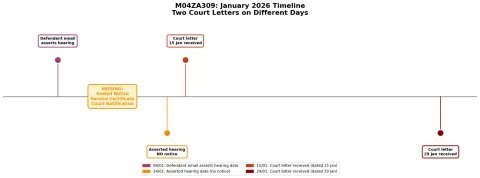
When a hearing exists only by assertion, procedure collapses into administrative fiction.
This disclosure documents a procedural failure in claim M04ZA309 where no sealed Notice of Hearing, service certificate, or court-issued notification was ever provided. The only indication of a hearing date arose from a party email on 8 January, unsupported by any public listing, court call, or official notice, following a 64-day period of administ…
Sources:
• Claimant correspondence to County Court Business Centre (CNBC)
• CNBC email correspondence and case transfer notifications
• Reading County Court letters and envelopes (dated and timed)
• Defendant email asserting hearing date (8 January)
• Absence of sealed Notice of Hearing (court-issued)
• Absence of Service Certificate for hearing notification
• HMCTS online court listings (January listings snapshot)
• HMCTS “Find a Court or Tribunal” public listings
• HMCTS published service standards and response time guidance
• HMCTS Equality and Inclusion Policy (publicly available)
• HMCTS Vulnerability Guidance (publicly available)
• Civil Procedure Rules (published statutory instrument)
• Human Rights Act 1998 (legislation.gov.uk)
• Equality Act 2010 (legislation.gov.uk)
• UK GDPR / Data Protection Act 2018 (legislation.gov.uk)
• European Convention on Human Rights (ECHR)
• International Covenant on Civil and Political Rights (ICCPR)
• UN Convention on the Rights of Persons with Disabilities (CRPD)
• UN Basic Principles on the Independence of the Judiciary
• Public reports, reviews, and documented complaints relating to Reading County Court administration
• Claimant master bundle and indexed exhibits (as served)
• Time-stamped screenshots evidencing online listing absence
• Postal evidence of delayed or irregular service
Legal Breaches Identified
I. Civil Procedure Rules (CPR) r.1.1
II. CPR r.1.3
III. CPR r.3.1
IV. CPR r.3.8
V. CPR r.3.9
VI. CPR r.6
VII. CPR r.12.3
VIII. CPR r.23
IX. CPR r.24
X. CPR r.30
XI. CPR r.52
XII. Human Rights Act 1998
XIII. Equality Act 2010 s.149 (Public Sector Equality Duty)
XIV. Data Protection Act 2018
XV. UK GDPR Article 15
XVI. Housing Act 1988
XVII. Administration of Justice Act 1970 s.40
XVIII. Protection from Harassment Act 1997
XIX. HMCTS Equality and Inclusion Policy
XX. HMCTS Vulnerability Guidance
XXI. Duty of Candour (Public Authorities)
XXII. Judicial Conduct (Judicial Code of Conduct)
XXIII. Freedom of Information Act 2000
XXIV. European Convention on Human Rights (ECHR) Article 6
XXV. ECHR Article 8
XXVI. ECHR Article 13
XXVII. International Covenant on Civil and Political Rights (ICCPR) Article 2
XXVIII. ICCPR Article 14
XXIX. UN Convention on the Rights of Persons with Disabilities (CRPD) Article 5
XXX. CRPD Article 12
XXXI. CRPD Article 13
XXXII. UN Basic Principles on the Independence of the Judiciary
XXXIII. UN Guiding Principles on Business and Human Rights
XXXIV. UN Human Rights Committee General Comment No. 32
Williams Lea – Unpaid Overtime, Time Equivalent Served (TES), and Health & Safety Threshold Breach
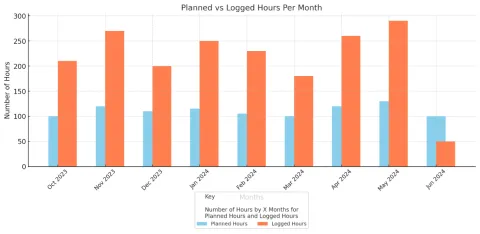
Quantified unpaid labour, documented systemic overwork, and foreseeable harm under law.
This disclosure documents sustained unpaid overtime evidenced by employer systems, including JIRA work logs covering October 2023 to June 2024, which were sufficient to demonstrate both the scale of excess hours worked and systemic failures in workload management. While project hours had been logged since at least August–September 2023, the evident…
Sources:
I. Consolidated Particulars of Claim — Ramdin v Williams Lea (ET Case No. 3300001/2025)
II. Background to Claim with Evidence (Claimant-authored evidential narrative)
III. Schedule of Loss and PHM Calculations (as filed)
IV. Subject Access Request (DSAR) Response — Williams Lea
V. JIRA Work Logs (August 2023 – June 2024)
VI. Chart of Planned vs Logged Hours (Oct 2023 – June 2024) — Exhibit 35
VII. Portfolio Case Studies Produced During Employment — Exhibit 36
VIII. Gantt Chart: Case Study Timelines & Workload Intensity — Exhibit 37
IX. Integration of Case Studies, Roles, and Contributions — Exhibit 38
X. Employment Contract, TOIL Policy, and Internal HR Communications
XI. Follow-up Emails from HR During Period of Medical Fatigue / Burnout
XII. GP Records and Medical Diagnosis Referencing Workload-Induced Burnout
XIII. Tribunal Case Management Orders and Directions (including video hearing reference)
XIV. Williams Lea Internal Systems of Record (Time, Task, and Delivery Reliance Evidence)
XV. Publicly Accessible Portfolio Evidence (webinmotion.co.uk case studies)
XVI. Prior Truthfarian Public Disclosures Relating to Williams Lea (Overtime / Workload)
XVII. Supporting Exhibits Referenced Within the Particulars of Claim
Legal Breaches Identified
I. Health and Safety at Work etc. Act 1974 — s.2(1) (General duty of employers)
II. Health and Safety at Work etc. Act 1974 — s.2(2)(a)–(c) (Safe systems of work)
III. Management of Health and Safety at Work Regulations 1999 — reg.3 (Risk assessment)
IV. Management of Health and Safety at Work Regulations 1999 — reg.13 (Capabilities and training)
V. Working Time Regulations 1998 — reg.4 (Maximum weekly working time)
VI. Working Time Regulations 1998 — reg.10 (Daily rest)
VII. Working Time Regulations 1998 — reg.11 (Weekly rest)
VIII. Working Time Regulations 1998 — reg.12 (Rest breaks)
IX. Working Time Regulations 1998 — reg.24 (Health and safety protection)
X. Employment Rights Act 1996 — s.1 (Statement of employment particulars)
XI. Employment Rights Act 1996 — s.13 (Unauthorised deductions from wages)
XII. Employment Rights Act 1996 — s.23 (Right to complain to tribunal)
XIII. Implied Term of Mutual Trust and Confidence (Common Law)
XIV. Common Law Duty of Care — Foreseeability of Harm (Donoghue v Stevenson [1932])
XV. Equality Act 2010 — s.6 (Disability)
XVI. Equality Act 2010 — s.15 (Discrimination arising from disability)
XVII. Equality Act 2010 — s.19 (Indirect discrimination)
XVIII. Equality Act 2010 — s.20 (Duty to make reasonable adjustments)
XIX. Equality Act 2010 — s.21 (Failure to comply with duty)
XX. Equality Act 2010 — s.26 (Harassment)
XXI. Equality Act 2010 — s.27 (Victimisation)
XXII. Equality Act 2010 — s.39 (Employees: terms, detriment)
XXIII. Equality Act 2010 — s.136 (Burden of proof)
XXIV. Employment Rights Act 1996 — s.43A (Protected disclosure)
XXV. Employment Rights Act 1996 — s.43B (Qualifying disclosure)
XXVI. Employment Rights Act 1996 — s.43C (Disclosure to employer)
XXVII. Public Interest Disclosure Act 1998 — s.47B (Protection from detriment)
XXVIII. Employment Rights Act 1996 — s.103A (Automatic unfair dismissal)
XXIX. Employment Tribunals (Constitution and Rules of Procedure) Regulations 2013 — Rule 2 (Overriding objective)
XXX. European Convention on Human Rights — Article 4 (Forced or compulsory labour)
XXXI. European Convention on Human Rights — Article 6 (Fair hearing)
XXXII. European Convention on Human Rights — Article 8 (Private and family life)
XXXIII. European Convention on Human Rights — Article 14 (Non-discrimination)
XXXIV. International Covenant on Economic, Social and Cultural Rights — Article 7 (Just and favourable conditions of work)
XXXV. Universal Declaration of Human Rights — Article 23 (Just remuneration)
XXXVI. ILO Convention No. 1 (1919) — Hours of Work (Industry)
XXXVII. ILO Convention No. 30 (1930) — Hours of Work (Commerce and Offices)
Gordons Partnership Solicitors LLP – Procedural Default and Absence of Defence
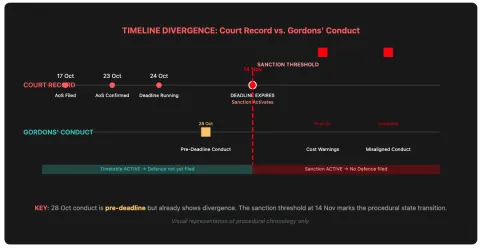
A documented case of defence default, sanction crystallisation, and post-deadline procedural misconduct engaging domestic and international legal protections.
This disclosure documents a clear procedural divergence between the court record and the conduct of Gordons Partnership Solicitors LLP following the filing of an Acknowledgment of Service. Despite the activation of the CPR timetable and the subsequent expiry of the Defence deadline on 14 November 2025, no Defence was ever filed and no relief from s…
Sources:
Court Record (Primary):
Civil National Business Centre (CNBC) court file → Acknowledgment of Service (AoS) notice → Court confirmation of AoS on record → Absence of Defence by CPR deadline → Absence of relief from sanctions order → Absence of consent order or extension.Correspondence Evidence (Defendant):
Gordons Partnership Solicitors LLP correspondence → instruction letter asserting representation → merits and strike-out assertions → costs exposure warnings → continued correspondence post-deadline → correspondence issued absent pleaded Defence.Postal / Service Evidence:
Royal Mail service envelopes → Whistl bulk-mail handling → date-stamped envelopes → proof of delivery chronology → temporal alignment with CPR timetable.Application Materials (Procedural):
N244 application materials (issued) → draft order (unsupported by Defence) → witness statement advancing merits → application pursued absent statement of case → no verified Defence under CPR r.22.1.Temporal Alignment Evidence:
Date-stamped documents → AoS filing date → AoS confirmation date → Defence deadline calculation → post-deadline conduct mapping → sustained divergence between court record and conduct.
Legal Breaches Identified
Civil Procedure Rules (England & Wales):
CPR r.15.4 (failure to file Defence within time) → CPR r.16.5 (absence of pleaded admissions/denials) → CPR r.12.3 (conditions for default judgment satisfied) → CPR r.3.8 (automatic sanction operative absent relief) → CPR r.1.3 (failure to assist the court in furthering the overriding objective) → CPR r.1.1 (undermining just and proportionate disposal) → CPR r.1.4 (interference with active case management) → CPR r.3.1 (mis-engagement of case management powers) → CPR r.22.1 (absence of verified statement of case) → CPR r.3.4(2)(b) (abuse of process) → CPR r.44.2 (improper costs conduct) → CPR r.44.11 (litigation misconduct by legal representatives) → CPR r.52.21 (procedural fairness principles engaged).Human Rights Act 1998 / European Convention on Human Rights:
Article 6 ECHR (right to a fair hearing; equality of arms) → Article 8 ECHR (interference with correspondence and procedural dignity) → Article 13 ECHR (denial of effective remedy through procedural obstruction) → Article 14 ECHR (discriminatory impact in enjoyment of Convention rights).International Covenant on Civil and Political Rights (ICCPR):
Article 14(1) ICCPR (equality before courts and tribunals) → Article 2(3) ICCPR (right to an effective remedy).UN Convention on the Rights of Persons with Disabilities (CRPD):
Article 5 CRPD (equality and non-discrimination) → Article 13 CRPD (effective access to justice).Universal Declaration of Human Rights (UDHR):
Article 7 UDHR (equality before the law) → Article 8 UDHR (right to an effective remedy).Common Law / Professional Regulation:
Abuse of process (common law doctrine) → improper use of procedural powers for collateral purpose → breach of duty of candour to the court → procedural intimidation and chilling effect → Legal Services Act 2007 ss.1 & 3 (regulatory objectives and professional principles) → Solicitors Regulation Authority Principles 2024 (Principles 1–5) → SRA Code of Conduct for Solicitors 2024 (Rules 1.4, 1.5, 2.1).
Medical Health Disclosure – Comprehensive Medical History with Supporting Evidence: June 2018 - December 2025

Documented clinical risk arising from disrupted care, delayed monitoring, and safeguarding failures across long-term treatment.
This disclosure sets out a consolidated medical history from 2018 to 2025, evidencing sustained clinical risk arising from gaps in monitoring, medication disruption, and failures in continuity of care. It documents persistent hyperglycaemia, repeated hypertensive episodes, and associated complications, including a suspected stroke event, alongside …
Sources:
Disclosure Sources
General Practice medical records (2018–2025)
NHS secondary care correspondence and referrals
Subject Access Requests (SARs) and SAR responses
Evidence of missing and deleted medical records (2018–2020)
Pathology and diagnostic test results (including HbA1c, renal markers)
Medication history and prescribing records
Hospital attendance and outpatient records
Consultant letters and clinical communications
Visual timelines and medical data visualisations derived from source records
NHS Constitution, NICE guidance, and clinical governance standards
Prior Truthfarian medical and safeguarding disclosures
No confidential or privileged material reproduced.
Legal Breaches Identified
Civil Procedure Rules (CPR rr.1.1, 1.2, 3.1(2), 3.3(4), 3.4(2), 24.2, 44.2)
Equality Act 2010 (ss.15, 20, 21, 149)
Human Rights Act 1998 (Articles 6, 8)
European Convention on Human Rights (Articles 6, 8)
ICCPR (Articles 2(3), 14(1))
UN Convention on the Rights of Persons with Disabilities (Articles 5, 13, 25)
Common Law – duty of care, foreseeability of harm, equality of arms
Judicial Code of Conduct (2024) §2.3
Data Protection Act 2018 / UK GDPR (Articles 5, 12, 15, 32)
NHS Constitution (duties of care, patient safety, continuity of care)
Governance Overlay and Judicial Non-Engagement in the Gopal Litigation

Public-interest disclosure documenting governance overlay and procedural non-engagement in civil litigation
This disclosure documents a publicly verifiable governance role held by the landlord party in Ramdin v Gopal and records its coexistence with observable judicial and administrative non-engagement across the related proceedings. Without alleging impropriety or motive, it preserves contextual evidence of structural asymmetry, where a disabled litigan…
Sources:
West Berkshire Council — Register of Interests
(Statutory register published under the Localism Act 2011 and the Relevant Authorities (Disclosable Pecuniary Interests) Regulations 2012)
Localism Act 2011 (Part 1, Chapter 7)
(Members’ interests, standards, and governance transparency obligations)
Relevant Authorities (Disclosable Pecuniary Interests) Regulations 2012
(Mandatory disclosure and management of pecuniary interests)
Judicial Code of Conduct (2024)
(Impartiality, independence, and avoidance of apparent bias)
Civil Procedure Rules and Court File Records
(Filed applications, listings, procedural orders, and administrative correspondence in Ramdin v Gopal)
Equality Act 2010 — Public Sector Equality Duty Guidance
(Court and public authority obligations where disability and vulnerability are notified)
Human Rights Act 1998 / ECHR Guidance
(Judicial obligations relating to fair hearing and respect for home and private life)
Truthfarian Archive — Related Disclosures and Bundled Evidence
(Cross-referenced procedural, medical, and housing evidence already published on the site)
Legal Breaches Identified
Civil Procedure Rules (CPR rr.1.1, 1.2, 3.3(4), 3.4(2), 24.2)
Equality Act 2010 (ss.20, 21, 149)
Human Rights Act 1998 (Articles 6, 8, 14)
European Convention on Human Rights (Articles 6, 8, 14)
International Covenant on Civil and Political Rights (ICCPR Articles 2(3), 14(1), 26)
UN Convention on the Rights of Persons with Disabilities (CRPD Article 13)
Common Law – equality of arms; procedural fairness; foreseeability of harm
Judicial Code of Conduct (2024) §2.3 (Impartiality and appearance of bias)
Localism Act 2011 (ss.29–34) and Relevant Authorities (Disclosable Pecuniary Interests) Regulations 2012
Williams Lea – Video Hearing Direction, Overtime Evidence Scope, and Procedural Posture

Procedural record of Tribunal-directed evidential scope and system-based overtime assessment
This disclosure records the procedural posture of the Williams Lea Employment Tribunal matter following tribunal directions for a video hearing. The Tribunal confined the scope of the hearing to overtime records and employer-controlled system logs, expressly limiting the evidential field. This entry documents that scope and the procedural tim…
Sources:
• Employment Tribunal Notice of Video Hearing
• Tribunal direction restricting evidential scope
• ACAS Early Conciliation Certificate
• ET1 claim submission and acceptance
• Employer-controlled overtime records
• Employer system logs (including JIRA / time-tracking systems)
• Procedural correspondence between parties and Tribunal
Legal Breaches Identified
Employment Tribunals (Constitution and Rules of Procedure) Regulations 2013
• Rule 2 – Overriding Objective (fairness, proportionality, efficiency)
• Rule 29 – Case management orders and directions
• Rule 41 – Tribunal power to regulate evidence and scope
Employment Rights Act 1996
• Section 13 – Unauthorised deductions from wages
• Section 94 – Right not to be unfairly dismissed
Working Time Regulations 1998
• Regulation 9 – Employer duty to maintain adequate working time records
European Convention on Human Rights
• Article 6 – Right to a fair hearing (procedural equality of arms)
This disclosure records tribunal-directed evidential scope only.
No findings, liability, or determination are asserted.
High-Value Claim Against DAC Beachcroft Disposed of by Deputy Judge Outside King’s Bench Jurisdiction
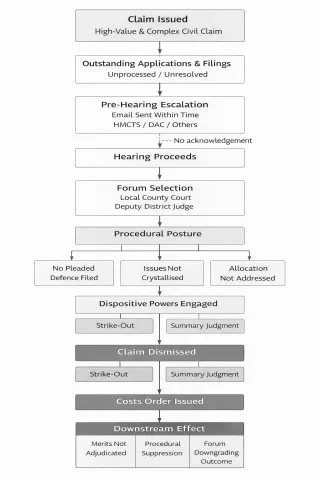
High-value civil litigation resolved through forum downgrading and procedural compression, foreclosing adjudication on the merits.
This disclosure documents the summary disposal of a complex, high-value civil claim through procedural routing to a structurally unsuitable forum. Despite advance notice, unresolved procedural filings, and the absence of a pleaded Defence, dispositive powers were exercised at local County Court level by a Deputy District Judge. Analysed with…
Sources:
Pre-hearing escalation correspondence (timestamped)
Court procedural records and order (N24)
Court file position (absence of pleaded Defence)
HMCTS procedural architecture and listing practice
Prior Truthfarian DAC Beachcroft disclosures
Associated unresolved applications and filings
Truthfarian equilibrium and procedural-suppression analysis
No confidential or privileged material reproduced.
Legal Breaches Identified
Civil Procedure Rules (CPR rr.1.1, 3.3(4), 3.4(2), 24.2, 44.2)
Equality Act 2010 (ss.20, 149)
Human Rights Act 1998 (Articles 6, 8)
European Convention on Human Rights (Articles 6, 8)
ICCPR (Articles 2(3), 14(1))
UN Convention on the Rights of Persons with Disabilities (Article 13)
Common Law — foreseeability of harm, equality of arms
Judicial Code of Conduct (2024) §2.3
DAC Beachcroft LLP – Costs-Threat Triggered Civil Claim and Procedural Bypass via Strike-Out

When costs pressure replaces adjudication and procedure is used to foreclose defence.
A costs-based threat issued during active Employment Tribunal proceedings was followed by the issue of a civil claim supported by extensive medical vulnerability evidence. Although the Defendant filed an Acknowledgment of Service indicating an intention to defend, no Defence was ever served.Instead, the Defendant pursued early termination of the cl…
Sources:
DAC Beachcroft LLP — Conflicts of Interest and Institutional Control
DAC Beachcroft LLP — Procedural Interference Through Unauthorised Communication
DAC Beachcroft LLP — Procedural Interference and Intimidation During Judicial Freeze
Reading County Court — Suppression and Procedural Breach
CNBC Failure to Respond Within a Reasonable Time
Tribunal Knowledge of Medical Vulnerability and Subsequent Procedural Detriment
Medical Denial — When Legal Defence Overrides Care
Legal Breaches Identified
Employment Tribunals (Constitution and Rules of Procedure) Regulations 2013, r.2 (Overriding Objective)
Civil Procedure Rules:
r.10 (Acknowledgment of Service)
r.15.2 (Defence to be filed)
r.3.4(2) (Strike out)
r.24.2 (Summary judgment)
Equality Act 2010: ss.20–21 (Reasonable adjustments); s.149 (Public Sector Equality Duty)
Human Rights Act 1998, Sch. 1, Art. 6 (Fair hearing); Art. 8 (Private life)
European Convention on Human Rights: Art. 6; Art. 8
International Covenant on Civil and Political Rights: Art. 2(3); Art. 14(1)
UN Convention on the Rights of Persons with Disabilities: Art. 5; Art. 13
Solicitors Regulation Authority Principles (2024): Principles 1–3
Public Interest Disclosure Act 1998
Common Law: Access to justice; abuse of process
Tribunal Knowledge of Medical Vulnerability and Subsequent Procedural Detriment
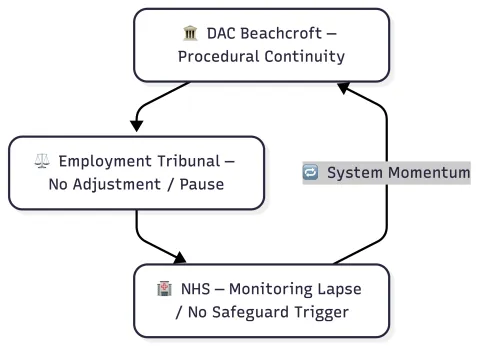
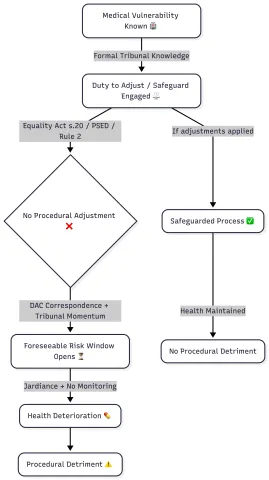
Recorded medical vulnerability followed by unadjusted process, exposing institutional inertia across law and care systems
This disclosure documents a tribunal process in which formal knowledge of medical vulnerability was established during live proceedings. That knowledge activated a duty to apply procedural adjustment or accommodation, shifting the system into a safeguarded state under Truth-Variant principles. Despite this, proceedings continued without adjust…
Sources:
Tribunal procedural records and case-management architecture
Published statutory frameworks (UK legislation and procedural rules)
Human rights instruments (ECHR, ICCPR) and associated jurisprudence
Equality and safeguarding duties applicable to public authorities
Regulated legal-services standards and professional conduct frameworks
NHS medication-monitoring standards and safeguarding expectations
Subject Access Request medical chronology (lawfully obtained)
Truthfarian proportional-harm and institutional-inertia analysis
Legal Breaches Identified
Human Rights Act 1998 — Article 6
Right to a fair hearing in the determination of civil rights and obligations, compromised by unadjusted procedure despite known vulnerability.Human Rights Act 1998 — Article 8
Interference with physical and psychological integrity through continued procedural pressure after vulnerability was formally recorded.European Convention on Human Rights — Articles 6 and 8
Failure to ensure fair process and respect for personal integrity once medical vulnerability was known.ICCPR — Articles 2(3) and 14(1)
Denial of effective remedy and equality before tribunals in circumstances of known vulnerability.Equality Act 2010 — Sections 20–21
Failure to make reasonable adjustments following formal notice of disability or impairment.Equality Act 2010 — Section 149 (Public Sector Equality Duty)
Failure by public authorities to have due regard to the need to remove or minimise disadvantage connected to disability.Employment Tribunal Rules of Procedure 2013 — Rule 2
Breach of the overriding objective to deal with cases fairly, justly, and on an equal footing.Data Protection Act 2018 / UK GDPR (Special Category Data)
Procedural handling of medical vulnerability information engaging heightened duties of care and lawful processing.Public Interest Disclosure Act 1998
Procedural detriment arising in the context of protected disclosures, including sustained pressure during a period of known vulnerability.Common Law — Natural Justice and Procedural Fairness
Failure to prevent foreseeable harm once vulnerability was known, rendering inaction unreasonable.
DAC Beachcroft Llp — The Tribunal Nexus and Institutional Capture

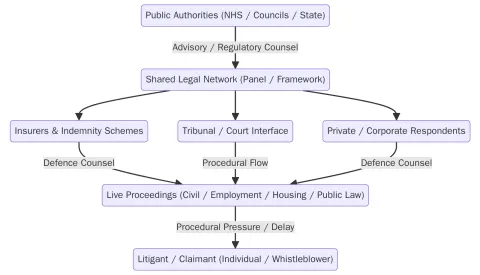
Structural convergence of advisory, defence, and adjudicative functions within UK tribunal systems.
Disclosure BasisPublic Interest Disclosure Act 1998 (PIDA)— publication of structural risk, governance imbalance, and systemic capture indicators, without attribution or allegation.This disclosure examines the structural convergence between advisory, defence, and adjudicative functions within UK tribunal and civil-justice systems, with DAC Beachcro…
Sources:
Public statutory frameworks (UK legislation and procedural rules)
Published regulatory instruments and codes of conduct
Open public procurement and panel-appointment records
General tribunal and court procedural architecture
Truthfarian proportional-harm and equilibrium analysis
This disclosure does not rely on, disclose, or reproduce confidential information, party communications, or privileged material from any named organisation or proceeding.
Legal Breaches Identified
Human Rights Act 1998 — Article 6 (fair trial), Article 13 (effective remedy)
European Convention on Human Rights — Articles 6, 8, 13
ICCPR — Articles 2(3), 14(1)
Equality Act 2010 — ss.20–21, s.149
Civil Procedure Rules — Parts 1, 3, 6
Employment Tribunal Rules 2013 — Rule 2 (overriding objective)
Legal Services Act 2007 — Regulatory objectives
SRA Principles (2024) — Principles 1–3
Public Interest Disclosure Act 1998
Common Law — natural justice, procedural fairness
Life-Threatening Heating Failure: A Triple-Agency (Landlord, Council, and Court) Safeguarding Collapse



A routine attempt to restore heating in a property already subject to live disrepair proceedings escalated into a life-risk electrical and flooding incident, following prolonged landlord neglect, council non-action, and court suppression of safety evidenc
A corroded radiator bleed/isolation valve failed catastrophically during a routine attempt to restore heating within a private rented dwelling already subject to live disrepair proceedings. The failure released uncontrolled water into a confined workspace containing live electrical fittings, legal documents, and computer equipment. The incident occ…
Sources:
• Exhibit — Radiator bleed/isolation valve showing corrosion and seizure
• Exhibit — Water discharge and emergency bucket containment beside live socket
• Exhibit — Wall-mounted light fitting with exposed live wiring above impact zone
• Exhibit — Consumer unit showing single B32 breaker for all sockets
• Exhibit — Photographs of water-damaged papers, electronics, and workspace recovery
Legal Breaches Identified
• Landlord and Tenant Act 1985, s.11 — Failure to maintain heating, water, and electrical installations
• Defective Premises Act 1972, s.4 — Foreseeable risk of injury and property damage from known defects
• Homes (Fitness for Human Habitation) Act 2018 — Occupation of an unfit dwelling
• Electrical Safety Standards Regulations 2020 — Unsafe electrical installation and lack of safe isolation
• Housing Act 2004 (HHSRS) — Failure to address Category 1 hazards
• Equality Act 2010 (ss.20–21, s.149) — Failure to accommodate known medical vulnerability
• Human Rights Act 1998 (Articles 2, 6, 8) — Risk to life, interference with access to justice, and unsafe interference with the home
• First Protocol, Article 1 ECHR — Interference with possessions
Grenfell-Risk Disrepair Retaliation — West Berkshire Council’s Fabricated Council-Tax Non-Compliance Narrative

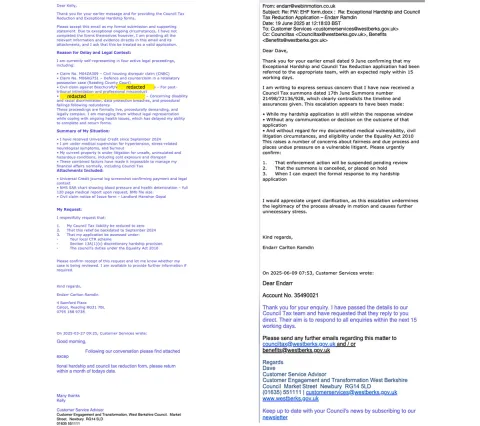
Despite full compliance, documented vulnerability, and a live hardship application, West Berkshire Council reframed lawful disclosure as non-cooperation and escalated council tax enforcement toward criminalisation.
On 30 June 2025, the claimant submitted the complete Exceptional Hardship Fund form, supporting documents, and full budget breakdown through West Berkshire Council’s secure portal. Despite the timestamped submission, the authority generated internal warnings alleging “failure to supply information”, a representation contradicted by the digital reco…
Sources:
• Secure submission screenshot (30 June 2025)
• Exhibit WA3 — Visual Timeline of Messages and Issues
• Email thread with West Berkshire Council (Benefits Team and Customer Services)
• Gas certificate (2020)
• “Dear British Gas” letter (Ref R0326179)
• Exceptional Hardship Fund form and budget statement
Legal Breaches Identified
• Local Government Finance Act 1992 (s.13A(1)(c)) — failure to consider hardship before enforcement
• Council Tax (Administration and Enforcement) Regulations 1992 (rr.34–36) — unlawful liability progression
• Fraud Act 2006 (s.2) — false representation of non-submission
• Equality Act 2010 (ss.20–21, s.149) — failure to apply vulnerability protections
• Human Rights Act 1998
CNBC Failure to Respond Within a Reasonable Time

A reply from the County Court Business Centre on 27 November 2025 was issued 51 days after the claimant's correspondence of 6 October 2025, delaying corrective action in landlord cases M04ZA309 and M00RG751.
This disclosure documents a 51-day administrative delay by the County Court Business Centre (CNBC) in responding to correspondence sent on 6 October 2025, with a reply issued only on 27 November 2025, well outside HMCTS’s own 10–20 day standard and 28-day maximum. The delay obstructed timely corrective action following a 1 September 2025 possession…
Sources:
Exhibit — CNBC Email (27 November 2025)
Exhibit — Correspondence to CNBC (6 October 2025)
Exhibit — Possession Order (1 September 2025)
Legal Breaches Identified
- Human Rights Act 1998 (Article 6) — Delay obstructed a fair hearing within a reasonable time.
- HMCTS Standards — 51-day delay exceeded the 10–20 day benchmark and the 28-day extended limit.
- Equality Act 2010 (Sections 20–21) — No reasonable adjustments for a vulnerable litigant.
- Equality Act 2010 (Section 149) — Failure to minimise disadvantage affecting a protected party.
- Civil Procedure Rules (CPR 1.1) — Departure from the overriding objective of expeditious and fair handling.
- Common Law Fairness — Public authority delay adversely affecting procedural rights.
DAC Beachcroft LLP — Procedural Interference and Intimidation During Judicial Freeze

Skeleton arguments, case-dumps, and court silence — how DAC Beachcroft escalated intimidation during a live judicial freeze in claim M05ZA443
On 14 November 2025, DAC Beachcroft LLP served a Skeleton Argument directly on the Claimant while Reading County Court was non-responsive: no acknowledgement of the Claimant’s N244, no confirmed listing, and no sealed order. This followed the unsealed 12 September 2025 letter attributed to DDJ Hocking, issued only by post, not logged on CE-File, an…
Sources:
- Improper Skeleton Service — Breach of CPR 23.7 and 39.5 by serving a skeleton argument without directions, listing, or sealed order.
- Abuse of Process — Conduct amounting to abuse under CPR 3.4(2)(b) by weaponising procedure against a vulnerable litigant.
- Jurisdictional Misrepresentation — Ultra vires statements regarding transfer contrary to Practice Direction 7A paragraphs 2.4–2.6.
- Record-Keeping Failures — Breach of HMCTS digital protocols, Public Records Act 1958 and Data Protection Act 2018 through off-record judicial correspondence.
- Fraud Act 2006 (s.2) — False representation of procedural authority through timing, format, and deployment of documents.
- Administration of Justice Act 1970 (s.40) — Harassment and intimidation by documentary overburdening and court-like communications.
- Human Rights Act 1998 — Violations of Articles 6, 8 and 13 through lack of fair hearing, transparency, and remedy.
- PIDA 1998 — Retaliatory conduct against protected disclosure within ongoing whistleblower litigation.
- SRA Principles — Failure to uphold the rule of law, to act with integrity, and to maintain independence from state-linked institutional capture.
Legal Breaches Identified
- I. Civil Procedure Rules — Parts 1, 3, 23, 32 and 39; Practice Direction 7A; Practice Directions 52A and 52C.
- II. HMCTS Digital Communications Protocol (2024) and Record Management Policy.
- III. Fraud Act 2006 — Section 2 (False Representation).
- IV. Administration of Justice Act 1970 — Section 40 (Harassment of Debtors – intimidation principles).
- V. Human Rights Act 1998 — Articles 6, 8 and 13 (ECHR incorporated rights).
- VI. Public Interest Disclosure Act 1998 (PIDA) — Protected disclosures and retaliation.
- VII. SRA Principles (2024) — Principles 1–3 and 5 (Rule of law, integrity, independence, standard of service).
- VIII. Truthfarian Evidence — Email threads, envelope evidence, and skeleton-argument service logs in M05ZA443.
Reading CC, Procedural Misstatement, Ultra Vires Commentary, and International Rights Interference
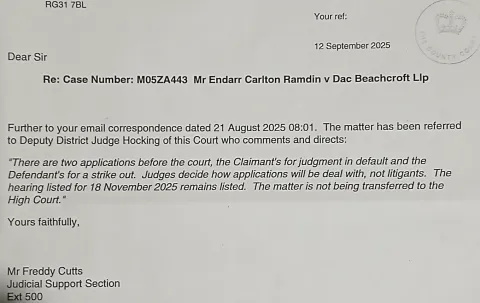
When official communication contradicts the Civil Procedure Rules, the procedural record collapses before the case reaches a judge.
This disclosure examines a letter issued through the Judicial Support Section that attributed procedural statements to a judicial officer which do not align with the Civil Procedure Rules, the Practice Directions, or the mandatory transfer criteria for high-value claims.The Truthfarian framework defines this event as procedural misstatement a devia…
Sources:
- HMCTS Digital Communications Protocol (2024)
- Civil Procedure Rules (Ministry of Justice)
- Practice Direction 7A — High-Value Claims
- Judicial Conduct Investigations Office — Standards of Judicial Behaviour
- Truthfarian Evidence — HMCTS Letter (12 September)
Legal Breaches Identified
I. Civil Procedure Rules, Part 23, Rule 23.6 — Statement of “applications before the court” inconsistent with filed record.
II. Civil Procedure Rules, Part 15, Rule 15.2 — No Defence filed; disposal cannot be advanced by the Defendant.
III. Practice Direction 7A, Paragraphs 2.4–2.6 — Mandatory High Court transfer criteria breached in a claim exceeding £10 million and involving public-authority issues.
IV. Civil Procedure Rules, Part 30, Rule 30.3(2)(f) — Failure to transfer where complexity and value require High Court allocation.
V. Human Rights Act 1998 / European Convention on Human Rights, Article 6 — Procedural fairness compromised by judicial mis-narration.
VI. Universal Declaration of Human Rights, Articles 7, 8 & 10 — Departure from equal protection, remedy, and fair-hearing standards.
VII. Magna Carta (1215), Clauses 39–40 — Delay and distortion of justice arising from procedural misstatement.
DAC Beachcroft LLP — Procedural Interference Through Unauthorised Communication (Email of 12 November 2025)

Direct solicitor–litigant contact using an unassigned service address during active proceedings, contrary to Civil Procedure Rules and professional-conduct standards.
This disclosure examines an email sent on 12 November 2025 by DAC Beachcroft LLP to Reading County Court and simultaneously to the Claimant’s private email address, despite no designation of email as an address for service and no procedural basis for direct contact during live proceedings. The communication sought to influence the handling of an up…
Sources:
- Civil Procedure Rules — Part 6 (Service of Documents)
- Solicitors Regulation Authority — Code of Conduct for Solicitors
- Equality & Human Rights Commission — Fair Hearing Standards
- Truthfarian Evidence — DAC Beachcroft Email (12 November)
Legal Breaches Identified
- Civil Procedure Rules, Part 6, Rule 6.3 — Service must use permitted methods; email requires explicit written agreement.
- Civil Procedure Rules, Part 6, Rule 6.23 — No designation of the Claimant’s private email as an address for service.
- Civil Procedure Rules, Part 15, Rule 15.2 — No Defence filed; the Defendant lacks standing to advance disposal or influence listing.
- Solicitors Regulation Authority Principles (2024) — Departures from independence, integrity, and proper administration of justice.
- International Covenant on Civil and Political Rights, Article 14 — Fair process affected by irregular solicitor communication.
- Universal Declaration of Human Rights, Articles 7 & 10 — Equality before the law and fair-hearing standards impacted.
- Vienna Convention on Consular Relations (1963) — Right of a Trinidad & Tobago national to notify consular authorities where procedural irregularities occur abroad.
Welfare Breakdown - Universal Credit and DWP Nexus Failures

Declared vulnerability ignored, lawful exemptions denied while algorithmic enforcement obstructed justice.
This disclosure documents a sustained and systemic breakdown in the administration of Universal Credit by the Department for Work and Pensions, in which statutory safeguards for medically vulnerable claimants and litigation exemptions were repeatedly ignored while enforcement actions continued. Between October 2024 and October 2025, declared vulner…
Sources:
- National Audit Office — Universal Credit Implementation (2024)
- BBC News — “DWP Faces Scrutiny over Vulnerable Claimants” (2025)
- Truthverian Evidence — EX 19 & 19A (SAR Acknowledgments Mar & Apr 2025)
- Truthverian Evidence — EX 21 (Rent Redirection and Journal Logs)
- Truthverian Evidence — EX 23 & 23A (Procedural Obstruction Thread Oct 2025)
Legal Breaches Identified
I. Equality Act 2010 (ss.20–21, s.149 PSED) — Failure to make reasonable adjustments and to safeguard disabled claimant.
II. Human Rights Act 1998 (Art. 6 & 8 ECHR) — Obstruction of fair trial and interference with private life through financial coercion.
III. Data Protection Act 2018 / UK GDPR (Arts. 5 & 15) — Dual SAR non-compliance and unlawful processing delay.
IV. Universal Credit Regulations 2013 (Regs. 99(3), 99(4)(c)) — Ignored litigation exemption and imposed sanctions while unfit for work.
V. Public Sector Equality Duty (EqA s.149) — No anticipation of compounded disadvantage or risk assessment.
VII. Public Interest Disclosure Act 1998 (s.43A et seq.) — Retaliatory omission following lawful protected disclosure.
EPC Fraud and the Circle of Institutional Collapse

How a single false EPC certificate exposed a feedback loop of corruption between landlord, council, revenue, and court.
What began as a dispute over an implausible EPC “C” rating for an unretrofitted 1980s property in Reading became proof of a self-reinforcing civic loop. Each institution landlord, council, tax authority, and court validated the same false data, turning one fabricated document into systemic truth.The Ramdin v Gopal case reveals that EPC fraud functi…
Sources:
Legal Breaches Identified
- Fraud Act 2006 (s.2) — False representation through knowingly inaccurate EPC data and subsequent judicial reliance.
- Energy Performance of Buildings (England & Wales) Regulations 2012 (rr.6–11) — Failure to verify or inspect before certification.
- Consumer Protection from Unfair Trading Regulations 2008 — Misleading commercial practice causing consumer detriment.
- Local Government Finance Act 1992 & Council Tax (Administration and Enforcement) Regulations 1992 — Retaliatory enforcement using falsified property data.
- Equality Act 2010 (ss.20–21, s.149 PSED) — Failure to accommodate vulnerability during enforcement and proceedings.
- Human Rights Act 1998 (Art.6 & Art.8) — Denial of fair hearing and violation of dignity through systemic neglect.
- Public Interest Disclosure Act 1998 (s.43A et seq.) — Protection engaged for disclosure of institutional collusion and falsified data.
Medical Denial - Theale Surgery & DAC Beachcroft: When Legal Defence Overrides Care

Head GP Dr Rock and her practice are now defended by DAC Beachcroft LLP, the same institutional law-firm nexus involved in multiple systemic cases. What began as a medical visit became evidence of legal governance replacing healthcare
Upon arrival at Theale Surgery, the patient raised a direct conflict of interest: Dr Rock, the head of the practice and a named party in related civil proceedings, was scheduled to see him. The request to reschedule with another clinician was refused. The appointment proceeded under protest an encounter already compromised by the surgery’s defence …
Sources:
1. NHS Constitution for England (2023)
2. GMC — Good Medical Practice (2024)
Legal Breaches Identified
I. Equality Act 2010 (ss.20–21) — Failure to make reasonable adjustments for a known disabled and litigating patient.
II. Equality Act 2010 (s.149 PSED) — Omission to eliminate discrimination and advance equality in healthcare access.
III. Human Rights Act 1998 (Art. 3 & 8) — Degrading treatment and violation of dignity through clinical neglect.
IV. NHS Constitution (Principles 1 & 4) — Breach of duty to provide care based on need, not circumstance or litigation status.
V. GMC Good Medical Practice (2024) — Failure to investigate, treat, or follow up on material symptoms.
VI. PIDA 1998 — Protected disclosure (10 Oct 2025 letter) ignored without acknowledgement or action.
VII. DPA 2018 / UK GDPR Art. 9(1) — Potential unlawful sharing or processing of confidential patient data by DAC Beachcroft LLP.
DAC Beachcroft LLP - Conflicts of Interest and Institutional Control



A 250-Year Pattern of Corporate Governance Masquerading as Justice
Evidence shows DAC Beachcroft LLP operating simultaneously as defence counsel for private insurers and as legal advisers to public authorities. This structural duality constitutes a persistent conflict of interest under the Legal Services Act 2007 and SRA Principles (2024), undermining impartial administration of justice and corrupting equality bef…
Sources:
1. UK Gov – DAC Beachcroft expands to Chile
2. Bristol Law Society – The History of DAC Beachcroft
Legal Breaches Identified
I. Breach 1 – Magna Carta (1215) — Denial and delay of justice through institutional capture.
II. Breach 2 – Common Law Maxim (Ubi Jus Ibi Remedium) — Suppression of remedy where right is acknowledged.
III. Breach 3 – Legal Services Act 2007 (ss.1–3) — Conflict with statutory objectives to protect public interest and rule of law.
IV. Breach 4 – SRA Principles (2024) — Failure to act independently and uphold public trust.
V. Breach 5 – Human Rights Act 1998 (Article 6) — Erosion of fair-trial rights through structural bias in representation.
VII. Breach 6 – Public Interest Disclosure Act 1998 (s.43A et seq.) — Retaliation and obstruction toward lawful whistleblower disclosures.
Reading County Court – Suppression and Procedural Breach
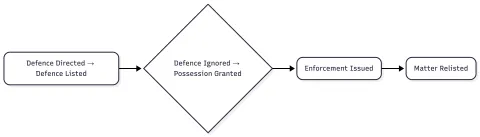

Suppressed filings, conflicting orders, and unlawful listings, a study in civic malfunction and systemic discrimination.
Case bundles transferred from the County Court Business Centre (CNBC) with all fees paid were later suppressed under administrative pretexts. Over 2,800 pages of evidence, including the full N244 Application, vulnerability statements, and medical certificates, disappeared from the live judicial file while contradictory directions were issued by mul…
Sources:
1. UK Parliament – Operations of the County Court Inquiry
Legal Breaches Identified
I. CPR r.6.14 & r.55.5(1) — Proceedings advanced without lawful service; suppression of hearing notice constitutes procedural fraud.
II. CPR r.3.1(2)(g) & r.30.3(2) — Refusal to consolidate or transfer to the High Court despite jurisdictional value > £4 million.
III. CPR r.55.8(2) — Possession order granted while live Defence and Counterclaim remained on file.
IV. CPR r.83.13(8) & r.83.26(1) — Unlawful enforcement and failure to notify the party of execution proceedings.
V. Equality Act 2010 (ss.20–21, s.149 PSED) — No reasonable adjustments made for a known disabled litigant; discriminatory administration of justice.
VI. Human Rights Act 1998 (Art. 6 ECHR) — Denial of fair hearing and equality of arms through record suppression and bias.
VII. Magna Carta 1215 (Clauses 39–40) — Denial and delay of justice contrary to constitutional guarantee.
VIII. Data Protection Act 2018 / UK GDPR Art. 15 — Failure to provide access to own case records and hearing transcripts.
IX. Judicial Conduct (JCIO 2024 Guidance) — Bias and dismissive language across multiple Deputy District Judges compromising impartiality.
X. ICCPR Art. 14 (1) — Unequal treatment before the courts and denial of effective remedy to a vulnerable litigant.